Friday, 15 November 2013

"A Shaggy great coat"

This is Forster No. 107, decribed in the 'Catalogue of Curiosities' as 'A shaggy great coat.'

1886.1.1124 Front of cloak

1886.1.1124 Back

It is a rain cloak, with an outer 'thatch' of plant material, mainly New Zealand flax but possibly also including kiekie (Freycinetia arboria).  The thatch is incorporated into the body of the cloak as it is made, held within the whenu weft structure.  Folded strips of plant material form each bundle of thatch.

Folded lengths of plant material are incorporated into the whatu as the cloak is made

Work on the cloak would have started at the bottom, using relatively unprocessed bundles of harakeke, New Zealand flax, as the aho warps.  The cloak is woven in the single pair weft twining technique (whatu aho patahi).  At the neck edge, the finishing point for the construction, the warp threads and additional plant material are made into a thick plaited edge.

Braided edge at top of cloak

Sometimes, garments such as this these are called 'rough' or 'coarse'.  Yet, as Mick Pendergrast writes in "Maori Fibre Techniques - Ka tahi hei tama tu tama (Auckland, Reed Books, 2005) this designation is 'unfair to the garments and their makers...the workmanship and design is often exquisite.'

Wednesday, 30 October 2013

A Cook-voyage Collection in Florence


The Duomo, Florence

Earlier this week I visited the Museo di Storia Natrale di Firenze where there is a collection of objects collected on Cook's voyages.  This was the first such collection to be systematically described and published, by Gignoli in 1893.  However, until work done by Adrienne Kaeppler, curator of Oceanic Ethnology at the Smithsonian Institution, in the 1970s, it was not certain which voyages the collection is from, or how exactly the objects came to Florence.  Kaeppler discovered that Giovanni Fabrioni, an Italian Scientist and director of the Mint in Florence, and Felice Fontana, director of the museum in Florence, were listed as purchasers at the sale of the collection of George Humphrey, an art dealer,  in London in 1779.  In addition, Fabrioni knew Joseph Banks, the naturalist on the first voyage, and could have obtained specimens from him, or from other collectors.  He may still have been in London when the third voyage ships arrived, and been able to obtain specimens from Hawaii and the Northwest Coast of America.

(see 'Cook Voyage Artifacts in Leningrad, Berne and Florence Museums' edited by Adrienne L. Kaeppler, Bernice P. Bishop Museum Special Publication 66, Bishop Museum Press, Honolulu, Hawaii 1978)

The Palazzo Nonfinito, Via Proconsul 12

Museum entrance
The Anthroplogy and Ethnology section of the museum is housed in the Palazzo Nonfinito ('unfinished palace'), Via Proconsul 12.  The Cook-voyage collections are displayed in two cases in a room with other Oceanic collections. 

Case displaying Cook-voyage collections
Second case - Tahitian Mourner's costume and Hawaiian objects

One of the most unusual parts of the collection in Florence is this painted barkcloth from Tahiti.  Other Tahitian barkcloths collected at the time are either plain, or decorated with red circles made by dipping the end of a plant stem on dye and using it as a stamp. 

Detail of decorated barkcloth


Thursday, 17 October 2013

'Three plain coats of the flax plant'

As discussed in a previous blog post, the Cook-voyage collections at the Pitt Rivers contain many Maori taonga or treasures.  I have been examining some of the textile taonga, in particular a kakahu (cloak) collected by the Forsters, 1886.1.1133.  Number 106 in the 'Catalogue of Curiosities given to Oxford' it is described as one of 'Three plain coats of the flax plant, two with dogskin at the corners'

The first step in being able to describe how a kakahu is made involves developing the correct vocabulary.  I've been following the terms used in the excellent book 'Whatu Kakahu/Maori Cloaks' edited by Awhina Tamarapa and published by Te Papa Press in 2011, as well as many other references to help me to describe the way that kakahu were made.

The term 'weaving' to describe the process of making a kakahu can be misleading.  They were made by weft-twining, a process in which two 'weft' threads (aho) are twisted around each other, enclosing 'warp' threads (whenu) as they twist.  No loom is involved, and the process is done entirely by hand.

Forster 106, 1886.1.1133.  The white triangles indicate the ends of the short weft rows, poka, used to shape the cloak

Forster 106 is a small kaitaka (a cloak with a fine undecorated foundation, edged with a border, normally of taniko, a decorative weft-twining technique developed only by the Maori.)  The kaitaka is of muka, the fibres extracted from the New Zealand flax plant (Phormium sp.)  The aho is made up of single pairs of threads (single-pair weft-twining - whatu aho patai).  There are shaping rows inserted into the weft.  These short rows - poka - allowed the cloak to hang gracefully over the body.

The foundation of the cloak, showing single-pair weft-twining (the horizontal fibres).  The end of one of the shaping rows is also visible.

The cloak is very finely made.  There are eight whenu warps per centimeter, and the spacing between the aho warps is only three or four millimeters. The cloak is is excellent condition, even after 250 years, and the flax fibre is still soft and lustrous.

The plain part of the border on this kaitaka is not taniko, but very closely packed rows of single-pair twining, creating a thick, dense fabric.  However, the patterned areas at the top and bottom of the border do appear to have been created using taniko techniques, where two colours are used in the twining process, with the colour not in use being hidden inside the wrapped threads.

The border of the cloak, showing the patterned edge, and the plaited finish.  A short fringe of whenu warp fibres also is visible.

Small tags of dog skin are attached to the cloak along both edges of the border.  A cord made from twisted muka has been threaded through the body of the cloak and looped around the strips to hold them - this possibly would have required the use of a needle, which would probably have been made of bird bone.

Dog skin tag, showing the method of attachment.

A fine cloak such as this would have been a prized garment, imbued with the mana of both its creator and its wearer.  Kaitaka were garments of prestige, worn to stress the importance of an event.

I am not an expert in Maori fibre techniques, but I hope that by documenting these taonga and sharing that information on the new Cook-Voyage collections website, people with more knowledge might be able to contribute to our understanding of these important cloaks.

Thursday, 3 October 2013

'A hatchet of green stone, the handle curiously carved.'

This blog post is by Conor Tulloch, our Icon HLF intern at the Pitt Rivers Museum.  

What is this and what’s it for?

1886.1.1159 Adze, New Zealand


Smaller and more ornamented than the average Maori adze, this particular ‘toki’ was probably never used as a tool. Rather it is a ceremonial weapon, the main function of which was likely to act as a symbol of the owner’s authority. High-status individuals (rangatira) could indicate their position on important occasions by carrying such ‘toki poutangata’ [‘the adze that establishes the standing of a person’] (Neich, 1997). 

Beyond this, it has been suggested that ‘toki poutangata’ were also used for the execution of captured enemies, as praiseworthy spoils of war, as significant objects to be exchanged in treaty, and as heirlooms, physically connecting its owner with their ‘venerated ancestors.’ (Keene, 2012). 

Where did this one come from?

Naturalists George Forster and his father Johann Reinhold Forster acquired this ‘toki poutangata’ in New Zealand on Captain Cook’s second voyage. Though the exact date they obtained the adze is not known definitively, it appears at least likely to be that described by Forster on the 4th of June 1773 as, ‘… a hatchet, of which the blade was of the finest green jadde, and the handle curiously ornamented with fretwork.’ In his journal entry for this date Forster writes how the, ‘hatchet’, was sold to them at Queen Charlotte Sound by Maori from the ‘opposite shore of the northern island, called Teera Whittee.’ 

Map of Queen Charlotte Sound, New Zealand
  
A similar adze illustrated in Cook's account of the Second Voyage

What’s it made from?

Nephrite  - the blade of the ‘toki’ is made of nephrite, a form of Jade. It is a hard, fine-grained, greenish mineral that, in New Zealand, is only found in particular waters of the South Island. Known as ‘pounamu’, nephrite was a highly valued and highly traded commodity in Maori life and was used to make a variety of tools, weapons, and ornaments.

 
1886.1.1159 - detail of nephrite blade
  
Flax -the type of flax found in New Zealand was essential to the Maori way of life. The common forms of this plant (Phormium sp.) were used variously in medicine, clothing, and tools. Here, the flax makes up the lashing that secures the nephrite blade to the wooden haft.
This type of flax, closely related to the day lily or Hemerocallis, and thus unrelated to linen flax, was greatly praised by George Forster in his journal entries.

Haliotis shell  - the inlaid eyes of the two carved faces in the handles are both made from shaped pieces of Haliotis shell. Also known as abalone, Haliotis is a genus of sea-snail endemic to New Zealand. Its iridescent appearance is somewhat similar to mother-of-pearl and is a common decorative feature in Maori craft.


1886.1.1159 Detail of eye


How was it made?

Blade - the blade of this adze has been shaped into a long, thin rectangle. The hewing end is beveled to an edge while the butt-end has been cut to accommodate the toe of the wooden haft. A perforation has also been drilled at this end to allow the lashing to pass through. Perforations like this are not found on adzes used as a working tool, probably as it weakens the structure of the nephrite and so shortens the useful life of the tool (Pearce, 1971).

A way of shaping nephrite was by sawing and filing with sandstone or greywacke flakes. Using these flakes with the addition of water, a groove can be incised into the nephrite. Into this groove, quartz sand, which is harder than the nephrite, can then be added to speed up the sawing process. This action would continue until the saw-line was deep enough to snap the nephrite cleanly or until it met an opposing groove, sawed from the other side.

Once the general shape of the ‘toki’ blade was established, the fine-grain of the nephrite would be polished on grindstone slabs (hoanga) of sandstone or mudstone. The hewing end of the blade would also be fashioned this way. One author describes the process in the absence of rotary grindstones: 

‘He takes his slab of sandstone to the nearest stream or pool, and places it therein in a slanting position, the lower end being under water. He "squats" down at the upper end, and rubs his implement up and down on the stone in a longitudinal manner, each downward movement taking the edge and part of the blade well under water. This assists the grinding process, and saves the operator the trouble of obtaining water and frequently pouring it on the surface of his grinding-stone.’ (Best, 2011)

The drilled hole would probably have been achieved using a weighted ‘stone-tipped pull-cord drill,’ the alternating rotation of which would produce a conical hole. This would meet with an opposing hole, drilled from the other side, to form an hourglass shaped perforation.

Lashing - the flax lashing here appears in two forms. In the photo below it can be clearly seen that the flat, straight plant fibres on the left have undergone fewer processes than the twisted, plaited fibres on the right. 

Detail of lashing
  
These fibres are obtained from the leaves of either of two indigenous Phormium species (Phormium tenax and P. coelensi, syn P. cookianum). The flesh is removed from the broad leaves using a sharp shell.

The flat fibres here are bound around the blade to the foot of the handle with a turn of cord running between the butt of the adze and the foot. The plaited cord however belongs to a different system of lashing and is not attached in any way to the flat fibres. Rather, the plaited cord runs through a hole in the foot of the handle that corresponds with the perforation in the adze. The cord is then passed through the nephrite from opposite directions and tied off at the top. 

Haft  - The haft (kakau toki) of this ‘toki poutangata’ is made of wood, the exact species of which had not been identified in this example. Its form, however, is common to Maori adzes and is well documented. The angle of the foot to the shaft is acute, having been derived from a secondary branch of a tree. A section of the primary branch would have been cut from the tree and then carved down to create a foot for the adze-blade (Best, 2011).

In the case of this haft, there is a perforation running through the width of the foot. This is unusual for adzes functioning as working tools (the blades of which are usually lashed to the foot directly without perforation) but is often seen in ‘toki poutangata’.


What does the decoration mean?

There are various assertions on the meanings of the curvilinear patterns and distinctive figures found in Maori carving. However it is misleading to give any definite interpretations. One publication on a New Zealand government website accounts much of the meaning given to these carvings to, ‘the perpetrator of [a] clever and successful hoax’, a member of the Arawa tribe who, ‘obligingly,’ misinformed the author of the book Maori Symbolism. Instead it is suggested that much of the carving was purely decorative and that the symbolism relating to the figures has been either exaggerated or was already lost by the time Europeans arrived. (McLintock, 2009).

Regardless, the fact remains that there are recurring patterns and motifs in Maori carving, some of which are present on this ‘toki’: 

Spirals are one of the most common motifs in Maori relief carving. These are usually not single spirals but are formed of interlocked pairs as illustrated below. One form of spiral here is the ‘rauru’, a curved variation of the ‘rauponga,’ which is a band of dog-tooth notches bordered with parallel grooves. 

Carved decoration on adze

In addition there are simple incised notches, more rectilinear bands of ‘rauponga’, and, of course, the two abstracted figures on the foot. Such abstracted figures are seen throughout Maori carving and it has been suggested that the basis of design in this tradition is built out of the human form. It can be seen that the anatomical features of the figure shown here is composed of distinct decorative elements. The four-fingered hand, splayed across the belly, is formed of simple rectilinear bands, while what appears to be the legs and arms are variations of the ‘rauru’.

Figure carved on heel of adze


Figure carved on base of handle

Best, E. (1912) 'Stone Implements of the Maori', Wellington: NZETC 

N. Thomas and O. Berghof (Eds) 'A Voyage Round the World, George Forster' Volume I, Honolulu: University of Hawai’i Press, 2000

Kaeppler, A. L.'“Artificial Curiosities”, An Exposition of Native Manufactures, Collected on the Three Pacific Voyages of Captain James Cook, R.N.'  Honolulu: Bishop Museum Press, 1978

Keene, B. (updated 2012) Pounamu – Jade or Greenstone – Symbols of Chieftainship, Te Ara – the Encyclopedia of New Zealand

Neich, R. 'Pounamu, Maori Jade of New Zealand', Auckland: David Bateman Ltd, 1997

Pearce, G.L. 'The Story of New Zealand Jade, Commonly Known as Greenstone', Auckland: Collins 1971

Swarbrick, N. (updated 2012) Flax and flax working - Māori use of flax, Te Ara - the Encyclopedia of New Zealand

McLintock, A.H. (updated 2009) Meaning and Symbolism, , Te Ara - the Encyclopedia of New Zealand
URL: http://www.TeAra.govt.nz/en/1966/maori-art/page-6


Wednesday, 18 September 2013

A Story of Reuse and Fermentation

This is another post written by Emma Schmitt, the Conserving 'Curiosities' project summer intern.

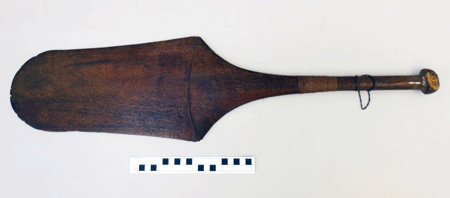
1886.1.1367 Paddle, Tonga

This carved wooden paddle from Tonga was listed by George Forster in 'The Catalogue of Curisoities Given to Oxford' as No 81 “A spatula of wood to mix up their paste of breadfruit with”.   

The form and shape of this object suggests that the object may have had a prior role as a dance paddle, used by men of high rank in a dance called me’etu’upaki (Kaeppler 1978). This term means ‘dance’ (me’e) ‘standing’ (tu’u) ‘with paddles’ (paki). The Forsters did not see this dance being preformed and thus probably had no knowledge of it. Cook, however, saw and described the dance during his third voyage:

‘It was a kind of dance, performed by men and youths of the first rank; ... Any number may perform it, there were in this one hundred and five, each having in his hand an Instrument shaped something like a paddle of 2.5 feet in length, with a small handle and thin blade so that they were very light and the most of them neatly made. With these Instruments, they made many and various flourishes each of which was attended with a different attitude of the body and some different movement or another They at first ranged themselves in three lines, and by different movements and motions each man changed his station in such a manner that those who were in the rear came in front. Nor did they remain long in the same form, but these changes were made by pretty quick movements; they at one time extended themselves in one line then formed into a semicircle and lastly into two square Columns, while this last was performing, one of them came and danced a harlequin dance before me with which the whole ended.’

Broken handle of paddle lashed together with plaited coconut fibre

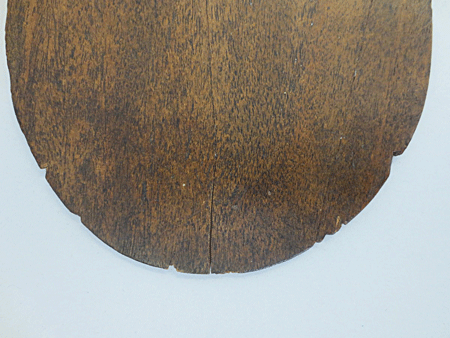
The Pitt Rivers’ paddle has been carved from native hardwood, and it is deceptively lightweight.  It was damaged at some point, the handle breaking away from the blade completely.  It was mended using braided coconut fiber to secularly wrap the break and hold the two pieces in place.  Chips to the wooden blade are on the edge of the blade, possibly indicating a long period of use.

Tip of paddle, showing damage

This pattern of damage indicates that the paddle may not have ended its time on Tonga as the prestige item it was first meant to be.  How can an object move from a prestige object used by elite men to a utensil of daily use? In simplest terms, the very fact that this was a prestige object is what saved it for repurposing.  The time, energy and material that went into creating such and object meant that, if it could be repaired it should not be thrown away.  It was probably no longer appropriate to be used during dances, but it could be used for another task, in this case the preparation of breadfruit paste.  The spatula’s role in the preparation of breadfruit paste is difficult to discern.  Methods of paste production have been documented, though not thoroughly, and tend to vary between the islands.  

The breadfruit tree grows throughout the south pacific and was a main source of food for the population of the islands Cook visited; it was also one of the products he traded for to keep the crew of the ships provisioned.  The fruit was out of season for some portion of the year making preservation of this staple imperative for the island communities. And earlier post here provides Joseph Banks’ description of the process as well as his opinions on taste: 

Banks’ opinion aside, the description he provides is helpful, but does not give any indication as to what a spatula may have been used for.  More modern discussions of the fermentation of breadfruit provide a fuller description of the later stages of the process.  

After the breadfruit has been buried, the period of time the fruit remains in the pits is variable, from a few months to years.  In fact in the 1980’s a pit was uncovered that was believed to be over 300 years old and the paste inside was deemed “still in edible condition” (Pollan, 2013).  It must be said that this was a rare find and the definition of  “edible condition” may very between people, however, the general thought is that breadfruit paste gets better with age.  

Overall, the management of these pits differs. In some cases fresh fruit may be added to the pits, or old paste mixed with new.  In other places, paste from year to year was kept completely separate (Pollock 1984). 

The paste, when eaten, goes through a preparatory process that involves mixing it with water, kneading, and baking.  Descriptions of the fermented paste indicate that is dry and possibly hard in its fermented form.
  
No direct reference is made to where in the process a spatula may be used, however, there are many times with both the fermentation process and the food preparation that such a utensil may have been put to use.  These include, but are not limited to, removing the paste from the pits if old and new paste were to be layered together or if paste was needed for food.  A spatula may have also been useful while mixing the paste with water before the kneading process.  

Objects like this are incredibly important because it makes us think differently in terms of use and reuse.  Had the Forsters not recorded what they saw as the use of the paddle we would be seeing it as a completely different object, not related to food preparation at all, but to the male members of society and the role of dance on the island; completely different cultural practices that wind up coming together in this simple object.  

Beaglehole, John Cawte, The Journals of Captain James Cook on his Voyages of Discovery The Voyage of the Resolution and Discovery 1776-1780, Hakluyt Society, Extra Series, 36, 1 u. 2. vol. 3, Cambridge University Press, Cambridge, 1955

Kaeppler, Adrienne L, ‘Artificial Curiosities’ Being An Exposition of Native Manufactures Collected on the Three Pacific Voyages of Captain James Cook RN [Exhibition catalogue], Bishop Museum Press, Honolulu, 1978

Pollan, Michael  Cooked: A Natural History of Transformation.  New York, The Penguin Press 2013

Pollock, Nancy J. Breadfruit Fermentation Practices in Oceania.  Journal de la Société des Océanistes, Vol 40 Issue 79, 151-164.  1984.