Showing posts with label Alexander Shaw. Show all posts

Thursday, 19 April 2012

Hawaiian Barkcloth

The Alexander Shaw Barkcloth book in the Pitt Rivers collection contains fifty-six samples.  Although each copy of the book is different, ours is very similar to the copy in the State Library of New South Wales, which has been digitised here.  The samples are clearly from the same original pieces of barkcloth, even the seventeen additions in the back of the book, although the State Library copy has additional samples.  There are also identical pieces of Hawaiian barkcloth in the copy of the volume held in Auckland Museum, photographed in 'Traditional Tapa Textiles of the Pacific' by Neich and Pendergrast, p93.

Many of the pieces of tapa in Shaw's book are from Hawaii.  Because of the early date of publication, these samples were almost certainly brought back from Cook's third voyage.

Hawaiian barkcloth reached a high level of sophistication, due in part to the climate of the islands, which was very suitable for the growth of the paper mulberry (Broussonetia papyrifera) and the breadfruit (Artocarpus incisa), which were the sources of the bark. 

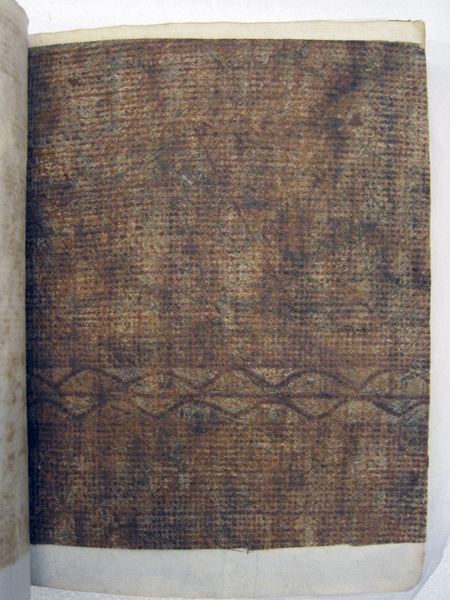
Barkcloth was given texture with patterned barkcloth beaters, or by using grooved boards to give a ridged texture.  These tapa were called kua'ula, and, unusually, were made by men.  The demand for it was great, and there was considerable production of this kind of barkcloth.

Sample 17 - ridged barkcloth, Hawaii


The fabric produced was often thick and cardboard-like, and had to be sewn together when making skirts or loincloths.  Bone or wooden needles were used, and the thread was made from bark fibre.


Sample 4 - sewn barkcloth, Hawaii


Dyes and pigments were obtained from a wide range of sources, mainly from plants but minerals such as red and yellow ochre were also used.  Tapa was often scented, with plants such as a fragrant fern (Polypodium phymatodes), sandalwood (Santalum spp.) and ginger.

Once dyed, decoration was applied to the surface of the tapa in many ways.  Many of the Shaw barkcloth samples are decorated with bold geometric designs, which were common in eighteenth century Hawaiian tapa.

Sample 2.  Freehand geometric decoration.  Hawaii


Some designs were applied freehand, but other samples are decorated with fine straight lines which were applied with a bamboo or wooden  'liner', shaped rather like a fork with several prongs, which was dipped in dye and drawn across the surface of the cloth, using a bamboo ruler to guide it.  These finer ruled designs became more popular in the nineteenth century.


Samples 23 and 24.  Hawaii.  Sample 24 is decorated with fine lines.
Sample 24 - detail of the surface.


The samples in the barkcloth book are in very good condition, and little conservation work is required.  Each page of the book will be photographed, and the digitised version made available on the new Pitt Rivers Cook-voyage collection website, which is one of the outcomes of this project.

Thursday, 12 April 2012

A Catalogue of the Different Specimens of Cloth Collected in the Three Voyages of Captain Cook...

Alexander Shaw, an army agent in London, saw a way of profiting from the interest aroused by Cook's voyages of discovery, and from the 'Artificial Curiosities' brought back to England by the participants.  He obtained pieces of barkcloth brought back from the Pacific, and cut samples from them which he bound into books. These were produced in 1787.

1908.28.1 Alexander Shaw Barkcloth Catalogue


An introduction was complied, partly from Reinhold Forster's 'Observations Made During a Voyage Round the World', in which the manufacture of bark cloth was described.  Each sample is listed, together with a description of how it was used.  These descriptions are not necessarily accurate.


Sample no. 2 'From Otaheite.  This is used to spread below the chiefs while at dinner'


Sample no. 6 'From Otaheite, used for bedding'


Some of the samples were thought to have been obtained from the sale of the Duchess of Portland's Museum, which took place in 1786.  The Duchess had a huge and diverse collection of objects, the largest in England, housed at Bulstrode Hall in Buckinghamshire, and after her death it was parcelled into over 4000 lots and sold at auction.  The sale began on Monday the 24th April, and lasted for the following thirty seven days (excepting Sundays, and the 5th of June, the King's birthday). The sale of the 'Artificial Curiosities from America, China and the newly-discovered Islands in the South-Seas' took place on the 13th day of the sale, and amongst the lots possibly purchased by Alexander Shaw were those listed in the catalogue as:

Lot 1376  Three large and two small specimens of cloth, made from the bark of the cloth tree, some of them curiously stained in a variety of figures, from Otaheite, O-why-hee! and other South Sea Islands

Lot 1377  Two large pieces of fine bark cloth, from the Society Isles

Lot 1378  Various specimens of the inner bark of the Lagetto tree (similar to the bark of the cloth tree of the South Sea Islands)…'

Sample no. 39 in many of the books is of Jamaican lacebark (Lagetta lagetto) and the description of lot 1378 explains why this material was added to the volume.


Sample no.39  'A fine specimen of the lace-bark, from Jamaica, bought at the Duchess of Portland's sale'

There are thought to be around 40 copies of this book in existence today.  Although the text in each is similar, the samples in each are different.  The Pitt Rivers volume, in addition to the 39 listed samples, has an extra seventeen pieces of barkcloth bound into the back.  A large number of the bark cloth pieces included are from Hawaii, and because of the date, it is very likely that these are from Cook's third voyage (1776-1779).
(See Kaeppler, A.L. '"Artificial Curiosities" An Exposition of Native Manufactures Collected on the Three Pacific Voyages of Captain James Cook, R.N.' Bernice P. Bishop Museum Special Publication 65, Bishop Museum Press, 1978)