Showing posts with label Barkcloth. Show all posts

Tuesday, 21 July 2015

Tongan Barkcloth

As I said in my last post on barkcloth, the large size of many of the pieces in the Cook-voyage collections makes it difficult to know how to display them.  In the past, the pieces were folded and stacked on shelves, but after many hours of conservation work to humidify creases we didn't want to fold the barkcloths again.  This is especially problematic for the Tongan barkcloths, which are thick and have a shiny, almost resinous surface. 

Tahitian barkcloth and mats, folded in a previous display

The solution for us was to roll the barkcloths onto a padded roll, overlapping them as we did so.  Most of the roll could then be hidden behind the structure of the case, with only small section of overlapping barkcloth being visible.

Tongan barkcloth mounted in the mock-up of the new case

Our next challenge is the Tongan fishing net, which is over 8m long...


Tuesday, 19 May 2015

Tongan Mats and Barkcloth

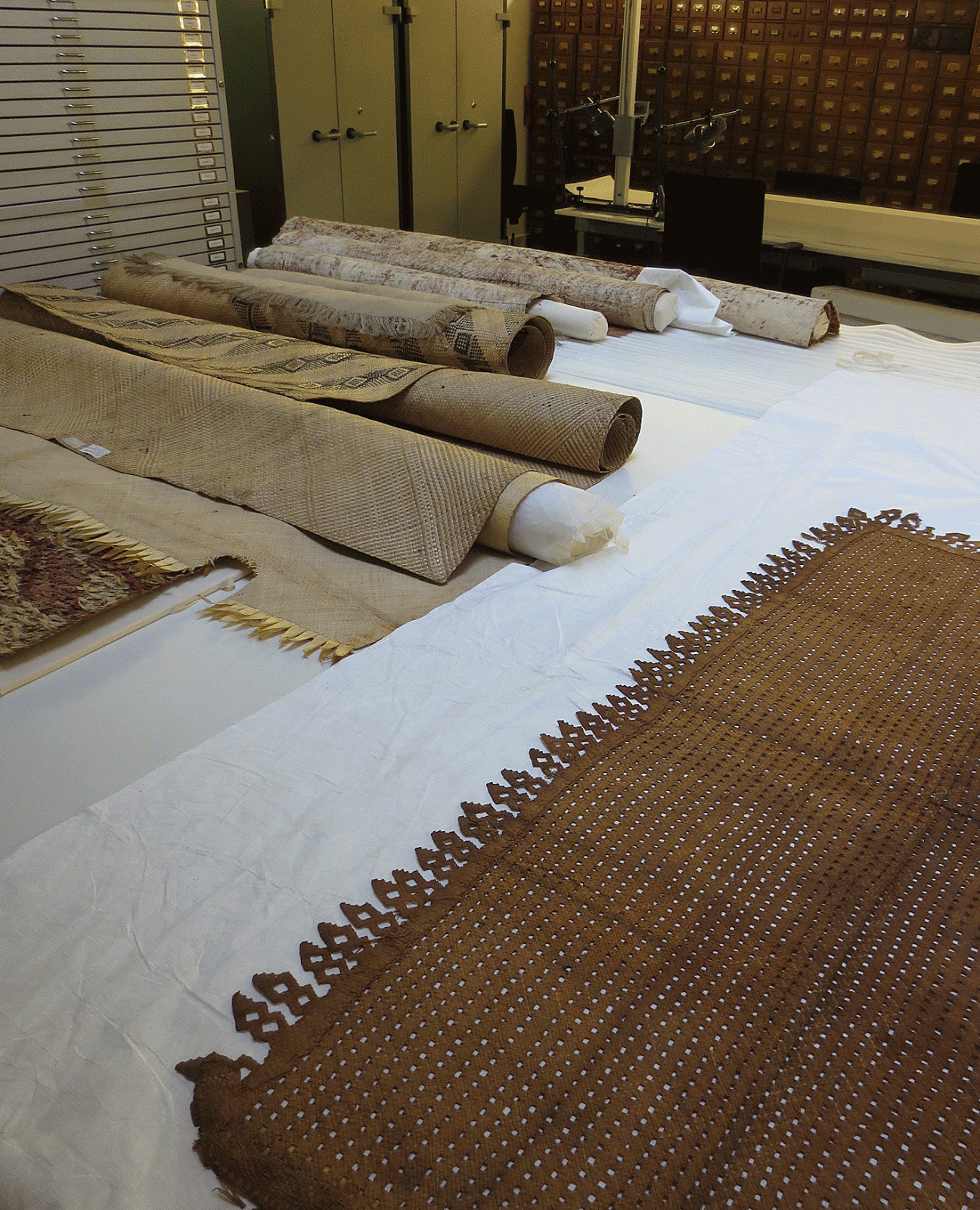
This week we've been laying out the Tongan barkcloth and mats so that the technicians can begin to prepare the mounts for the new case.


Because of the relatively large size of the barkcloth it has to be rolled for the most part.  Some of the smaller mats, and the overskirts such as the sisi fale, seen on the right in the picture below, will be more visible.

Case layout - the top of the image represents the top of the case

Thursday, 16 April 2015

Tahitian Barkcloth

Chris and Al, the Pitt Rivers technicians working on the new Cook-voyage display, have mocked-up the case to make the process of mount making and object installation easier.  Otherwise, this work would have to be carried out in the Lower Gallery, causing disruption to visitors for longer than is necessary.  Only when all the mounts have been made and the objects placed according to the design, will the final installation into the real case occur.

One of the first challenges we've been working on is how to display the Tahitian barkcloth.  Even though the new case is 8 metres long and nearly 3 metres high, there still doesn't seem to be much room!

In previous displays, the barkcloth has been folded, and often other objects placed on top.  We wanted to recreate something of the feel of this type of display, but at the same time wanted to avoid creating deep creases in the barkcloth, which can be caused by folding them tightly.  We needed to find a way to reduce the size of the barkcloth too, and reluctantly decided to omit 1886.1.1248 which at over 12 metres long was too big to fit in at all.

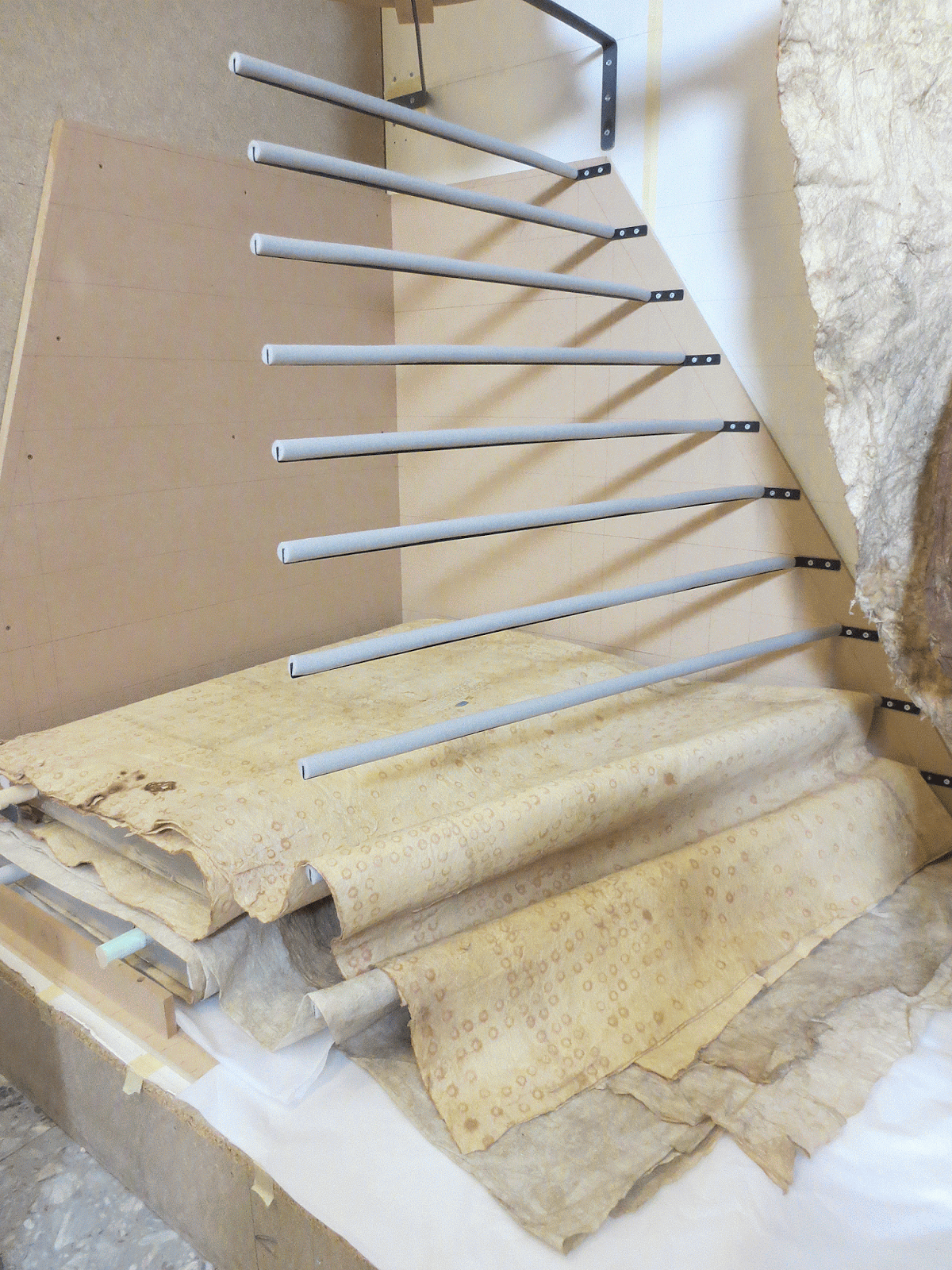
The solution was to roll the barkcloths over oval-shaped rolls, reducing the height of each roll, meaning that we could fit more into the space available.  A section of barkcloth could extend from the roll, and be held over a padded metal bar - this is the model Chris and Al made to illustrate the concept - you can see it allows us to stack the barkcloths in a limited space but still give an idea of the different colours and designs on the cloth, as well as the sheer volume of barkcloth collected.

Model of barkcloth mount

The next stage was to make the rolls - they were constructed from zero formaldehyde MDF with inert foam edges.  The rolls were covered with Moistop barrier foil and aluminium tape to seal the surface, as the barkcloth was rolled directly onto them. 

Ironing Moistop barrier foil onto the rolls

Careful calculations of the space available and barkcloth sizes allowed us to sort the barkcloths into their positions in the stack.  The barkcloths were rolled onto the supports, with a measured amount protruding from the roll to hand over the padded bar.

Preparing to roll a barkcloth

Once rolled, the supports could be slotted into position in the case mock-up, and the barkcloth arranged over the bars.

The bottom two barkcloths in position


Monday, 1 September 2014

A Black Stripe

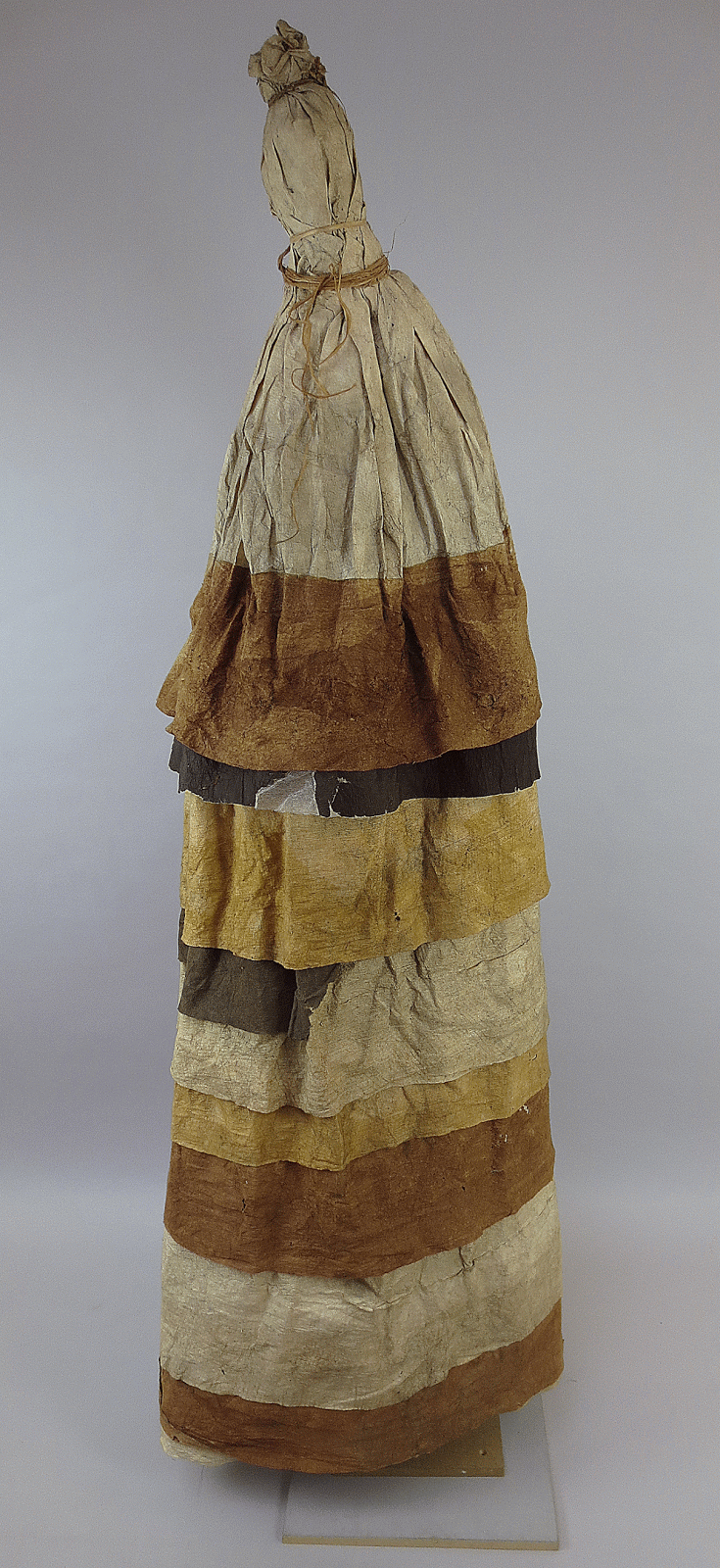
For the last few weeks, we've been working with Rachael Lee from the Textiles Conservation section at the Victoria and Albert Museum to help us make a mount for the Tahitian Mourner's costume.  The costume will be one of the highlights of the new display of Cook-voyage objects which will open in 2015.  The new display case which will house this exhibition is being installed this week in the Lower Gallery of the Pitt Rivers, and the re-mounted Mourner's costume will use almost the entire 2.7m height of this case. 

A few months ago, I blogged about finding a strip of barkcloth in one of our stores which I was sure was part of the Mourner's costume headdress.  Once in the lab, it was possible to confirm that this was the case - the strip was exactly the right length to fit back on the cape in the expected position.

Barkcloth strip before conservation treatment


Expected position of black strip

The barkcloth was very fragile, and couldn't be handled without damage.  It was necessary to line the strip with very fine Japanese tissue, a strong paper with long fibres, leaving a tab at the top to attach to the white barkcloth under-layer of the cape.  The adhesive used for this was a made from arrowroot and sodium alginate - it is a fairly 'dry' paste but strong enough to support the strip when hanging from the cape.  Small magnets were used to hold the barkcloth in place until the paste was dry.

Small magnets holding the tissue tab at the top of the black barkcloth strip in position

The two parts of the cape have been reunited after 120 years - one thing that is more noticeable now is the extent to which the barkcloth of the cape has faded after being on display almost continously for almost 250 years, compared with the black strip which has been in storage. 

Cape after treatment

Thursday, 5 September 2013

'A Black Piece' revisited

This post was written by Emma Schmitt from the Textile Conservation MPhil at the University of Glasgow, who is the summer conservation intern on the Conserving 'Curiosities' project.

Barkcloth 1886.1.1256

'Upon arriving at the Pitt Rivers Museum I was shown the bark cloth object on which it was assumed I would spend most of my time.  The “black piece", as it was listed in Forsters Catalogue, is an interesting and singular object in many ways.  The cloth itself is constructed of three layers, two of plain white bark cloth and one of a decorated black cloth.  The decoration, similar to that seen on the headdress of the Pitt River's second Tahitian mourner’s costume, is itself, rare in form.

1886.1.1637 .9 Headdress, Tahitian mourner's costume

Detail of barkcloth on headdress

At first glace this object is a bit scary, as you can see there are many areas of loss, but on top of that the black cloth appears to be flaking apart in some areas and powdering in others.  The painted areas easily lift up from the surface of the black bark cloth taking both the paint as well as bark fiber with it.  Every time the piece moves other small fragments are lost.


Detail of 1886.1.1256 showing surface damage

The construction of the object has had an effect on some of the damage.  The layers of this cloth have been lightly pasted together.  The black bark cloth has been pasted down in a rather haphazard manner causing creases and folds to form.  These folds can be seen in the photo and, in some places, correspond to the areas where the piece has been damaged. 

Black dyed fibers overall are susceptible to damage for one main reason.  Black dyes tend to be very high in tannin and iron and thus very acidic.  In an acidic environment the fibers can break down at the molecular level eventually leading to visible damage, like we see on this object.  For the most part black dyes in the South Pacific were made using extracts of bark, high in tannin, followed by immersion in mud that would have been high in iron.  Earlier research on this cloth shows that the black portion of the cloth is high in iron, explaining why the barkcloth was breaking down. 


1886.1.1256 - detail of surface under microscope x24

On initial examination of the painted decoration it looked as if white paint had been applied to the black cloth. However, under magnification, the paint appears to have originally been black and, for an unknown reason, appears to have bloomed with a whitish powdery substance.  The question was raised as to whether or not the paint might be a Western paint, brought on Captain Cook’s earlier voyage.  Without chemical analysis of this paint this question is difficult to answer.  The fact that the paint may be black, instead of white, means that it could easily be a local resin.  This still leaves the possibility of it being a Western paint open to speculation. 

While the investigation into the piece leaves numerous questions unanswered it posed a number of conservation issues which led to some interesting experimentation. 

As mentioned, this bark cloth is in poor condition, however it is a rare piece and thus incredibly important to the Pitt Rivers collection.  When we started to discuss possible treatments consolidation of the surface was discussed, to prevent the continuing loss of the back fiber.  Consolidation is the process by which an adhesive is applied to a surface to bind a material together to prevent further loss.  In many cases this is something down to more rigid objects like flaking or powdery painted surfaces.  In dealing with bark cloth the flexibility of the cloth is important and maintaining that flexibility is key to the treatment. 

Research into different methods of consolidation led to the work of Rangi Te Kanawa, a Maori Conservator based at The Museum of New Zealand Te Papa Tongarewa.   Ms. Te Kanawa’s work focuses on the conservation of Mari Cloaks.  Her recent research has lead to the use of sodium alginate, a seaweed based gel, as a consolidate for black dyed New Zealand flax.  Her research showed that, not only did the sodium alginate bind the deteriorating fibers together, but it also had the added benefit of neutralizing some of the acids that are the result of the mud-based dye process. 

Sodium alginate has not been applied to bark cloth by Ms. Te Kanawa so it was unknown how it would affect a very different material.  We set up an experiment to see whether or not the treatment would have a beneficial effect.  Solutions of sodium alginate were made up in various concentrations.  Using fragments of bark cloth from a store of unaccessioned samples we applied the solutions to a dry bark cloth fragment with a brush and allowed them to dry.  The result of the treatment was a metallic sheen on the surface of the bark cloth samples, reminiscent of mica, and a slight stiffening of the material.  Checking of the pH of the samples before and after treatment showed that there had been no change in the acidity of the cloth. 


Unaccessioned fragments of deteriorated barkcloth consolidated with sodium alginate solutions of varying concentrations

A second test was run to see if wetting the cloth through humidification could reduce the metallic sheen.  It was hoped that by wetting the cloth first, the sodium alginate would be drawn into the bark cloth, thus leaving less on the surface.  This treatment was successful in reducing the sheen, however, a test of the pH showed that there was still no change in the acid levels and the fabric still retained the slight stiffening see in the original tests.

Overall the experiment showed that this type of treatment may not be appropriate for bark cloth.  This may be because of the structure of the fabric as the beaten fibers lack the directionality seen in woven fabrics and thus move differently.  The lack of affect it had on the acidic pH as well as the metallic sheen and change in handle made the treatment less than ideal for “the black piece” collected by the Forsters.  An object of such importance and rarity should be treated in a way that is safe and will not visually change the object.   In the end, ‘the black piece’ had a custom-padded board and box constructed for it that will allow it to lay flat and be stored safely, in hope that in the future a treatment may be able to stabilize it and preserve it for future generations.'

Thursday, 1 August 2013

A Chance Discovery

The Pitt Rivers Museum was founded in 1884 when General Pitt Rivers, an influential figure in the development of archaeology and evolutionary anthropology, gave his collection to the University.  The ethnographic holdings of the Ashmolean were transferred to the Pitt Rivers in 1886, including the Forster collection.

Sometimes, objects, or fragments of objects, were transferred and the provenance was unknown.  Research into these is ongoing, and that's why I happened to notice a strip of barkcloth, waiting to be investigated, in one of our store rooms.  It carries the blue label which indicates that it came from the Ashmolean, and a note with it said that it has no provenance or number.

Barkcloth strip with blue Ashmolean label

On examining the strip of black-dyed, brittle barkcloth, two things struck me - that it was very similar in appearance to a strip of black barkcloth on the cape of the Tahitian Mourner's costume, largely missing, and that the remains of paste or gum along one long edge of the strip indicate that it was originally pasted onto something else, similar to the way that the differently coloured barkcloth strips are pasted onto the cape.

Remains of paste along the top edge of the strip

Closer investigation of the cape was difficult, as the Mourner's costume is currently on display in 'exploded' form.  However, we managed to take the hat and cape out of the case and examine the damaged black barkcloth stripe - there was no doubt that it was identical to the piece I had found.  Slightly puzzling was the fact that the loose strip was about 10cm too long to have been the missing part of this black stripe.

Expected position of barkcloth strip on Mourner's Costume cape

Looking at the cape, it appears that there is an entire stripe of barkcloth missing, as the pattern of stripes is broken near the top.  Lifting the remaining barkcloth strips, it's possible to see the underlying piece of barkcloth to which they are all pasted.  There, just where I had expected, were residues of a line of paste, with fibres of black barkcloth embedded in them. The length of the missing stripe corresponded  to the length of the barkcloth strip that I'd found in the store.  There is no doubt that the missing strip of barkcloth was the piece I had found, which must have been separated from the costume for over 120 years.

Actual position of barkcloth strip on cape

When the Mourner's costume is taken off of display in preparation for remounting as part of a new Cook-voyage display after the end of this project, I will reattach the strip of black barkcloth and reunite the pieces of the cape.

Thursday, 18 July 2013

'A black piece'

Emma Schmitt, a MPhil student in textile conservation, based at the Centre for Textile Conservation, Glasgow University, started at the Pitt Rivers on Monday.  She will be with us for eight weeks, working on Cook-voyage objects for the Conserving "Curiosities" project.

1886.1.1256 Barkcloth, Tahiti

Emma's first project is to investigate a piece of barkcloth, collected on Tahiti - Forster No. 18 'A black piece'. It has three layers-the bottom two are recognisably Tahitian, but the top layer, with its fish-scale like appearance, is very unusual.

Corner of barkcloth, showing deterioration

There are several questions we hope to answer about this barkcloth - why is the black layer deteriorating so badly?  What has been applied to the surface to create the dotted decoration? (There has been a suggestion that this might even be a European paint obtained on a previous voyage).


Microscope image showing detail of applied dots


Is the black barkcloth even originally from Tahiti? Emma will spend time trying to answer some of these questions, and investigating conservation treatments for the fragile barkcloth.

Friday, 28 June 2013

Photographing Barkcloth

Last week we photographed some of the large backcloths and mats from the Cook-voyage collections here at the Pitt Rivers.  This takes a bit of planning, as the only way to do it is to use the Researcher's Room, which has a light well opening into the floor above.  We can lay the barkcloth out on the floor or table, and take a photo by leaning over the railing. One barkcloth, recorded as being in three pieces, turned out to actually be a single piece, over 12m long - much too big even for that space!  Here are a few of the images, which will soon be available on the Pitt Rivers online databases, and on the new Cook-voyage collection website, currently under construction.

.
Barkcloth, Tonga  1886.1.1225


Mat, Tonga  1886.1.1172

Barkcloth, Tahiti  1886.1.1234

Barkcloth, Tahiti 1886.1.1240

Mat, Tonga 1886.1.1174


Tuesday, 18 June 2013

'A fire in the ship'

On Monday 1st August 1774, the Resolution was off the coast of Erromango, one of the islands of Vanuatu.  In 'A Voyage Round the World' George Forster described a terrifying incident as they approached the island  - 'Towards ten o'clock, we were most dreadfully alarmed by a fire in the ship.  Confusion and horror appeared in all our faces, at the bare mention of it; and it was some time before proper measures were taken to stop its progress: for in these moments of danger few are able to collect their faculties and to act with cool deliberation.  The mind which unexpected and imminent danger cannot ruffle for a time, is one of the scarcest phænomena in human nature; no wonder then, that it was not to be met among the small number of persons to to whom the ship was entrusted.  To be on board of a ship on fire, is perhaps one of the most trying situations that can be imagined; a storm itself, on a dangerous coast, is less dreadful, as it does not so entirely preclude all hopes of escaping with life.  Providentially, the fire of this day was very trifling, and extinguished in a few moments.  Our fears suggested that it was in the sail-room; but we soon found, that a piece of Taheitee cloth, carelessly laid near the lamp in the steward's room had taken fire, and raised a quantity of smoke, which gave the alarm.'

Burn marks on 1886.1.1235 (Forster No. 15)

Detail of damage to 1886.1.1235

Several pieces of barkcloth in the Forster collection have burn marks on them, which had always puzzled us.  Could the fire on board the Resolution be the reason why?  Interestingly, during a visit last week from Adrienne Kaeppler, curator of Oceanic Ethnology at the National Museum of Natural History at the Smithsonian Institution in Washington DC, a barkcloth thought possibly to be from Hawaii was identified as Tahitian, and it too has significant fire damage.   

Barkcloth 1886.1.1253.1 Showing more extensive fire damage

We are fairly sure that there are several 'lost' barkcloth pieces from the Forster collection in the Pitt Rivers museum, but since they have lost their labels, or maybe didn't ever have a unique Forster Number label (for example, Forster No. 48 in the Catalogue of Curiosities is described as 'Another parcel of Otaheitee cloth' and it is unlikely that each had a label) identification is difficult.  We can be fairly sure however that this newly discovered piece of barkcloth is part of the Forster collection - and maybe even the piece mentioned by Forster, 'carelessly laid near the lamp in the steward's room…'

Wednesday, 6 March 2013

Surprising Barkcloth

Sometimes, objects can surprise us.  The barkcloth mentioned in the last post, 1886.21.19, was collected in Tahiti by Joseph Banks and donated by him to Christ Church, his old Oxford College.  Our museum database suggested that it was nearly 4 metres long, and just over a metre wide.
Once the barkcloth had been brought to the Conservation Lab for treatment, it was soon obvious that these were the folded measurements.  The piece of barkcloth actually measures 3.35m wide by 3.85m long.

Barkcloth fully unfolded

In our small conservation lab objects this size can pose a problem.  It was impossible to open the barkcloth out fully, and the processes of surface cleaning and reinforcement of tears had to be carried out by keeping the barkcloth rolled at each end, like a scroll, and working on the small unrolled section.  We had to decide how to store the barkcloth, and came to the conclusion that our stores could only accomodate it if it were folded in half and then rolled.  Folding it needed the largest tables in the museum, found in our Researchers area, and it was amazing to see such a large sheet of fine, almost translucent barkcloth and to think about how it would have been made, probably by groups of women working together.  The barkcloth is so finely beaten, however, that there is no evidence of any joins.

Folding the barkcloth

The barkcloth has been rolled for storage around a custom made support sewn from calico and filled with polyester wadding.

Monday, 25 February 2013

Cook and La Perouse

While working on a very large barkcloth this week (1886.21.29, a barkcloth from Tahiti collected on the first voyage by Joseph Banks) I was listening to a biography of Marie Antoinette.  In her final prison of the Conciergerie the ci-devant French Queen apparently liked to read tales of foreign adventures, her favourite being the Travels of Captain Cook.  This was translated into French for Louis XVI - a special edition was made for the edification of the Dauphin.


Posthumous portrait of Marie Antoinette, the Widow Capet, in her cell at the Conciergerie

Louise XVI and Marie Antoinette had admired Cook and followed his voyages - the Queen is said to have wept at the news of Cook's death.

In 1785, Jean Francois de Galaup, Comte de La Perouse was made Minister of the Marine in France, and charged with leading an expedition around the world to complete Cook's Pacific discoveries.

Louis XVI and La Perouse (1785, Edouard Nuel)

La Perouse left Brest on the 1st August 1785, and visited Chile, Easter Island and Hawaii before sailing to Alaska, California, East Asia, Japan, Russia and the Pacific.

Map of La Perouse's voyage

After visiting Australia, the expedition was lost, and its fate not confirmed until 1964.  Both of La Perouse's ships, L'Astrolabe and La Boussole, were wrecked on the reefs around Vanikoro, in the Santa Cruz islands.  However, documents were regularly sent back to France and an account of the voyage was published in 1787 by the French Government as Voyage de La Perouse autour du monde (La Perouse's Voyage Around the World).

Friday, 8 February 2013

More about Pesticides

In a previous blog post, I wrote about pesticide residues on museum objects, and the work being done as part of this project to attempt to identify pesticide residues on objects from the Cook-voyage collections at the Pitt Rivers Museum.  

Detail of barkcloth 1886.1.1240, showing staining and associated damage

This week, I've been taking more samples to send off for analysis.  It has been noticeable that many of the barkcloths I've conserved so far have had areas of staining on them, often associated with damage to the structure and weakening in the stained area.  We're starting to suspect that this damage might be the result of the application of pesticides in the past.  

One of the problems when thinking about pesticides and their effects is that the chemicals were available in many different formulations, with lots of ways of applying them.  These methods include dissolving pesticides in water or other solvents and spraying or misting objects, or the objects could just have been dusted with a powder. The same pesticide could have been applied in different ways at different times.

Whilst we understand that the past use of pesticides on museum collections has saved them from the devastating effects of insect damage, and, we suspect, in many cases, continues to do so, the effects of these pesticides both on objects and on those who work with the collections are not yet properly understood.

A 30x30cm area of barkcloth framed within a temporary border

Here, I am taking samples of surface residues from a large barkcloth collected in Tahiti on Cook's second voyage.  The barkcloth is about seven meters long, and there are areas of staining in several places.  I've made a frame so that I can take surface swabs from an 30cm by 30cm section - this may help us to make a rough estimate of how much pesticide remains on the surface of the entire barkcloth.


Using swabs barely dampened with distilled water to remove residues from the surface of the barkcloth

Friday, 4 January 2013

'A piece of their brown cloth.'

This is another piece of barkcloth from Cook's second voyage - Forster No.49, listed in the section for the Friendly Isles (Tonga) as 'A piece of their brown cloth.'

1886.1.1239 Barkcloth, Tonga


Original Forster number label, together with labels added at the Ashmolean Museum before transfer to the Pitt Rivers in 1884.

Barkcloth, together with mats, are amongst the possessions most important to Tongans, who regard them as koloa, or wealth.  Adrienne Kaeppler write in her essay 'Tonga - Entry into Complex Hierarchies' in 'James Cook - Gifts and Treasures from the South Seas. The Cook/Forster Collection, Gottingen' Prestel-Verlag, Munich 1998, that 'koloa, made by women, are complimentary to ngaue, products derived from agricultural work and animal husbandry, and produced by men.  Koloa, products made by women, are prestigious, as are the women themselves.  In contrast, products made by men are considered 'work', and like the men are powerful.  The ngaue of men regenerates people physically, while the koloa of women regenerates them culturally.  Both are necessary to regenerate and reproduce society…the fabrication of koloa is not a craft, but a fine art which creates valuables, an important distinction in Tongan culture.'

The majority of barkcloth on Tonga is made from the paper mulberry.  At the time of Cook's voyages, the bark was stripped from the tree and briefly soaked to soften it.  The strips were placed on a wooden anvil and beaten out with a grooved beater, folding them and beating several thicknesses, then shaking the folds out and beating again, until the width of the strips had increased from 8-10cm to as much as 50cm.  Two of these sheets were felted together, to form a piece of tapa (on Tonga, this term referred only to undecorated barkcloth) called a feta'aki.  These were dried in the sun, and then stored in the houses of women.  Tapa was thus always available for making ngatu, large decorated sheets of barkcloth.

The ngatu collected by the Forsters in either October 1772 or June 1773 is a ngatu 'uli, or black ngatu.  Sheets of feta'aki were pasted together with arrowroot, and at the same time dye was rubbed into the surface of the barkcloth.  The fact that the sheets were pasted together means that there are no beater marks visible on the surface of the barkcloth, and the texture is different to backcloth from, for example, Tahiti. 

The pasting and dyeing process was carried out on a curved wooden board called a papa 'koka'anga, to which textured tablets or kupesi could be attached to give a pattern to the surface of the finished barkcloth.  The kupesi were usually made from palm leaf and sheath, carrying an embroidered relief design, or coconut fibre cords and leaf midribs were attached directly to the wooden base.  These design tablets could not withstand being beaten, hence the need to paste and rub the feta'aki strips together. Sometimes matting was stretched over the papa to form a design, and this is what seems to have been used on the central panel of the Pitt Rivers barkcloth. 

Pattern on the surface of the central panel

The border has a design of parallel lines, similar to patterns formed by using cords attached to the papa directly. 

Pattern on border panels
 (See Kooijman, 'Tapa in Polynesia', Bernice P. Bishop Museum Bulletin 234, Bishop Musuem Press, Honolulu, Hawaii 1972).  

A liquid brown dye was obtained from the bark of the koka tree (Bischofia javanica, Bishopwood) and this was rubbed into the surface of the ngatu using a pad of barkcloth.  The dye probably helped the layers to stick together, and gave the surface a glazed appearance.  The surface was blackened using a dye in powder form, fukai tutui, made from burnt candelnuts (Aleurites moluccana), which was sprinkled over the surface of the ngatu and rubbed in with a pad soaked in koka dye.  The black dye was difficult to make, requiring several days and nights of work, and was one reason for the high status of ngatu 'uli. 

Monday, 19 November 2012

A Large Clothbeater

1886.1.1550 Barkcloth Beater

Forster 24 is 'A large clothbeater' from Tahiti.  Barkcloth beaters from Tahiti were usually made from ironwood or toa (Casuarina equisetifolia).  Kooijman reports in 'Tapa in Polynesia' (Bernice P. Bishop Museum Bulletin 234, Hawaii 1972) that in addition to the general Polynesian term ie for beaters, the word toa was also used.

In general, beaters were square in section, with the corners rounded off to form the shaft.  Each side of the beater was grooved, with the grooves increasing in fineness.  The beater was used to beat out the inner bark of whichever tree was being used to make the barkcloth - usually the paper mulberry (Broussonetia papyrifera) but the breadfruit (Artocarpus sp.) and types of fig tree were also used.

'Native implements, Otaheite'from Hawkesworth, 1773, showing a barkcloth beater.

Barkcloth beating took place in a special shed, and each family had such a shed.  The strips of prepared inner bark, two or three layers thick and damp, having been soaked in water overnight, were laid on a wooden anvil (tutu or tutua).  The anvil could be up to 9 meters long, with a width of up to 25cm.  Beating started with the coarsest side of the beater.  As the bark became thinner and started to spread out, it was necessary to move progressively to the finer-grooved sides, ending with the finest.


Bark fibres caught in the finest side of the barkcloth beater (x10)

The best kind of barkcloth on Tahiti was called hobu, and was made by folding a piece of paper mulberry bark several times while beating.  It was kept wet by sprinkling it with water, and was a thinner and softer cloth than ordinary tapa.  Joseph Banks described the manufacture of this type of tapa, and said that the very finest kind was made by wearing the hobu until it became even more supple, then washing it and beating it again with the very finest beaters.  The tapa was also bleached in the sun, to give it a fine white colour. 

Barkcloth manufacture on Tahiti disappeared soon after Western contact, to be replaced with woven cloth.  Herman Melville wrote in 1847 that 'the echoes of the cloth-mallet have long since died away in the listless valleys of Tahiti.' (Omoo: A Narrative of Adventures in the South Seas Being a Sequel to the "Residence in the Marquesas Islands").

Friday, 14 September 2012

'In the shape of a large tooth'

Europeans first encountered the Marquesas in 1595, when the Spanish Explorer Alvaro de Mendana de Neira named them Las Islas de Marquesa de Mendoza and claimed them for Spain.  The next European visitor was Cook, who arrived at the beginning of April 1774.  Cook anchored for several days at Vaitahu, on Tahuata, in the same harbour used by Mendana.

George Forster, in 'A Voyage Round the World' notes that the inhabitants 'looked almost black, being punctured (tattooed) over the whole body.'  Some of them, once they had sold their fruit and vegetables to the sailors on board the Resolution, 'came on board to be gazed at, and to gaze.' Forster also described the many ornaments worn by the Marquesans, observing that 'the number of ornaments, in some measure, might be said to supply the want of clothing.' He went on to say that some 'wore a string around the neck, and fastened to it a piece of shell, which was cut and polished in the shape of a large tooth.' (See George Forster, 'A Voyage Round the World', N.Thomas and O. Berghof (Eds) Vol.1. University of Hawaii Press, Honolulu, 2000).

There are two of these shell ornaments in the Cook-voyage collections at the Pitt Rivers, collected by the Forsters.  In the 'Catalogue of Curiosities' they are numbers 139 and 140, 'Two bones (or teeth of porpoises?) hung before the neck.'

1886.1.1540 (left) and 1886.1.1541 (right)

The pendants are made from shell, probably from the mouth of a helmet shell (Cassidae sp.) They are carved to resemble whales teeth, which were a valuable commodity on the Marquesas, and reserved only for those of high status.  The Marquesas had few fringing reefs, and few sperm whales were stranded there, as occurred elsewhere in Polynesia.  The fact that shell was carved to resemble whale teeth (skeuomorphs - objects made from one material in the form of another) shows how important whale ivory was to the Marquesans.  The cord is made from strands of barkcloth, which have been twisted together.

See also Steven Hooper, 'Pacific Encounters, Art and Divinity in Polynesia 1760-1860' British Museum Press, 2006, and Eric Kjellgren with Carol S. Ivory, 'Adorning the World - Art of the Marquesas Islands', Metropolitan Museum of Art, 2005.