Showing posts with label Tahiti. Show all posts

Wednesday, 10 February 2016

Tahitian Mourner's Costume Mounting

We recently installed the Tahitian Mourner's costume into the new Cook-voyage case.  To make the complex mount on which the costume is displayed, we worked with Rachael Lee, Textile Conservation Display Specialist at the Victoria and Albert Museum.  Rachael writes:

'In the summer of 2014, I spent time in the conservation lab with Jeremy and the team to start work on a new display mount for the Tahitian Mourner’s costume, as part of the Cook voyage redisplay. The brand-new display case posed an exciting opportunity to re-interpret the Mourner’s costume as a full three-dimensional ensemble that would illustrate the decorative scale and social status of the Chief Mourner during the elaborate mourning ceremony.

Pearshell mask and wooden breastplate

At the Victoria and Albert Museum, I’m more used to working with 18th century bodices and breeches rather than 18th century barkcloth. A large part of my job is to mount historic dress and contemporary fashion for safe museum display. This involves adapting a wide range of mannequins and making bespoke underpinnings, to replicate an accurate silhouette and realistic body shape, close to that of the original wearer. In doing so, items of clothing can be well understood in terms of the cultural context in which they were designed and made, and subsequently worn or used.

Before and after mounting: Dress (robe a l'anglaise), about 1785, Museum no.IM.39-1934. Copyright Victoria and Albert Museum, London

Mounting is an important final stage in the conservation process. Without it this robe à l’anglaise is at risk of strain and potential damage. After careful mounting and full support the robe is safe for display and the true shape of this late 18th century fashion revealed.

Initial assessment: neither Jeremy nor I were quite tall enough to measure the top of the tropicbird feathers!

Despite the obvious differences between Western fashionable attire and Polynesian ceremonial dress, the same method was applied in order to create a new mount that would maintain the safety of all nine elements of the Mourner’s costume. Below I outline some of the key stages involved in creating the new mount.


Adapted buckram torso with aluminium wire arms

We selected a buckram male torso that was slightly smaller than needed to allow for several layers of polyester wadding to be applied, creating a soft foundation for the initial barkcloth tiputa to rest against. We then added a pair of adjustable arms to the torso that can be raised and widened, creating a human T-shape. The arms further support the barkcloth and hold the sleeves of the feather cloak.

Three of the underpinnings made for the barkcloth tiputa and Pandanus matting apron

As the costume consists of many layers worn one on top of the other, it was necessary to make individual underpinnings that would help to control and define each part of the costume. The underpinnings also restrict contact between textured surfaces, minimizing friction and easing potential creasing.


To provide a firm yet soft support for the pandanus hat and barkcloth bindings, we also modified a buckram head with layers of plastazote® and polyester-wadding.
The head alone could not take further weight from the pearl-shell mask and wooden breastplate, so technicians Chris and Al custom-made a discreet steel bracket with security clips. This fixes at the neck of the torso and holds these heavy and fragile components securely.


Hands were cast from a fibreglass mould and finished with a stretch jersey cover

As intended, once all nine elements of the costume are dressed, no part of the mount is visible. However to help bring balance and symmetry to the large proportions of the costume, we somehow needed to add hands to the articulated arms. The solution? Fosshape! Fosshape is a non-woven, low-melt polyester fibre that can be easily moulded into different shapes with the application of heat. We found it to be a great alternative to standard mounting materials, as its lightweight properties didn’t add unnecessary bulk to the arms.

Installing the costume
The Mourner's costume in its full glory

The costume is now safely installed in the brand-new display case, which fittingly accommodates the imposing breadth and height of the chief Tahitian Mourner. We hope that this new interpretation, as a complete wearable ensemble, is easier to understand and highlights the unique decorative composition of this awe-inspiring costume.

Jeremy and I are really pleased with the outcome and hope that the conservation teams at the PRM and V&A will collaborate on future projects, to further develop costume mounting techniques for ethnographic dress.'

The stop-frame animation below shows us mounting the Mourner's costume for photography, and shows clearly the many complex layers of the costume and the mount created by Rachael.


Monday, 8 June 2015

A Feather Headdress

The feather headdress on the Tahitian Mourner's costume surprised us when we dismantled the Cook-voyage display back in 2009 and took the costume apart for the first time for over 20 years.  We expected the headdress to be a single object, when in reality is was made up of seven bundles of feathers tied around the top of the hat. 

Detail of construction of feather bundles

Each feather is split along the vane from the tip almost to the end. They are then bound, both individually and in groups of two or three, by coconut fibre cord. Four of these small bundles of bound feathers are then attached to a loop of coconut fibre. Four, or sometimes more, of these loops are then threaded on to a thicker cord made from twined barkcloth to form an individual feather bundle. There appears to be some distinction in size of feather used between bundles: feathers of approximately the same size are used in each bundle. The bundles were attached to the headdress with a string made from loosely twined barkcloth.

Feather headdress and mounts before assembly

The feather headdress is the final part of the costume to be mounted.  Chris and Al, the museum technicians working on the display, made a ring from firm, inert Plastazote foam which fits over the top of the hat and rests on the bindings. 


Plastazote ring covered in linen scrim

The ring was covered with scrim, a loosely woven linen fabric, to disguise the ring. Separate wire mounts, covered in a plastic covering to protect the feather bundles, were inserted into the foam around the ring, spaced to hold the bundles in position to give the appearance of a headdress.

The headdress in postion on the costume

Tuesday, 5 May 2015

Tahitian Mat

Mounting a large mat from Tahiti to the back wall of the new case was the next challenge we faced.  We decided the answer was magnets!  Small rare earth magnets have been used to mount barkcloth and textiles for several years now.  They have the advantage that they are small, but very strong, easily powerful enough to hold a mat in place.

Applying steel tape to the board

Finished board
 
The first step was to make a board slightly smaller than the mat from zero-formaldehyde MDF.  To provide a metallic surface under the mat for the magnets to stick to, we used strips of steel tape, which were riveted to the board to make sure they stayed in place for the duration of the display. 

The magnets were covered with synthetic tissue, which had been painted with acrylics to tone into the mat.  Once in place, they are almost invisible.

Mat mounted on the wall of case mock-up

Thursday, 16 April 2015

Tahitian Barkcloth

Chris and Al, the Pitt Rivers technicians working on the new Cook-voyage display, have mocked-up the case to make the process of mount making and object installation easier.  Otherwise, this work would have to be carried out in the Lower Gallery, causing disruption to visitors for longer than is necessary.  Only when all the mounts have been made and the objects placed according to the design, will the final installation into the real case occur.

One of the first challenges we've been working on is how to display the Tahitian barkcloth.  Even though the new case is 8 metres long and nearly 3 metres high, there still doesn't seem to be much room!

In previous displays, the barkcloth has been folded, and often other objects placed on top.  We wanted to recreate something of the feel of this type of display, but at the same time wanted to avoid creating deep creases in the barkcloth, which can be caused by folding them tightly.  We needed to find a way to reduce the size of the barkcloth too, and reluctantly decided to omit 1886.1.1248 which at over 12 metres long was too big to fit in at all.

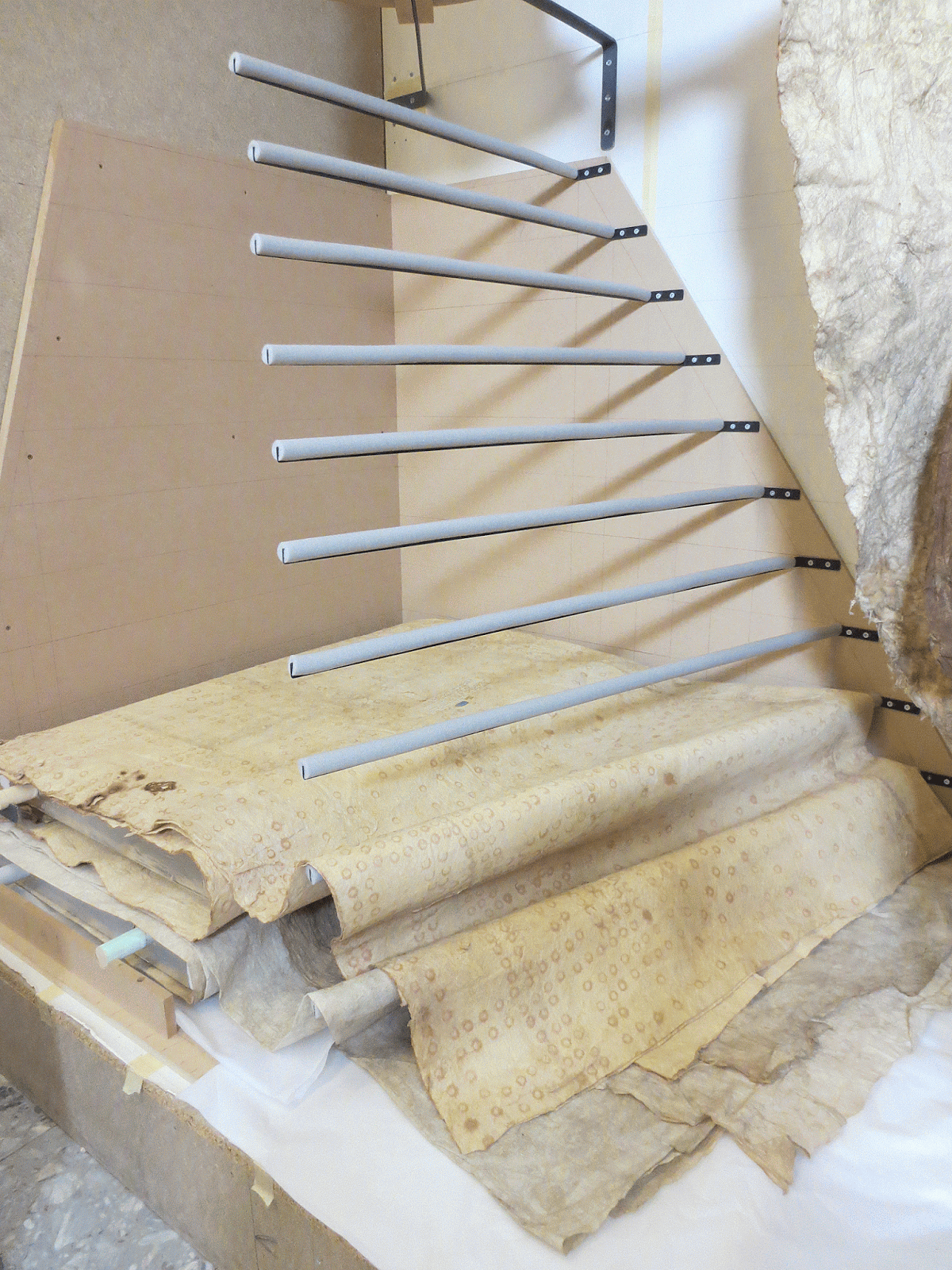
The solution was to roll the barkcloths over oval-shaped rolls, reducing the height of each roll, meaning that we could fit more into the space available.  A section of barkcloth could extend from the roll, and be held over a padded metal bar - this is the model Chris and Al made to illustrate the concept - you can see it allows us to stack the barkcloths in a limited space but still give an idea of the different colours and designs on the cloth, as well as the sheer volume of barkcloth collected.

Model of barkcloth mount

The next stage was to make the rolls - they were constructed from zero formaldehyde MDF with inert foam edges.  The rolls were covered with Moistop barrier foil and aluminium tape to seal the surface, as the barkcloth was rolled directly onto them. 

Ironing Moistop barrier foil onto the rolls

Careful calculations of the space available and barkcloth sizes allowed us to sort the barkcloths into their positions in the stack.  The barkcloths were rolled onto the supports, with a measured amount protruding from the roll to hand over the padded bar.

Preparing to roll a barkcloth

Once rolled, the supports could be slotted into position in the case mock-up, and the barkcloth arranged over the bars.

The bottom two barkcloths in position


Thursday, 20 November 2014

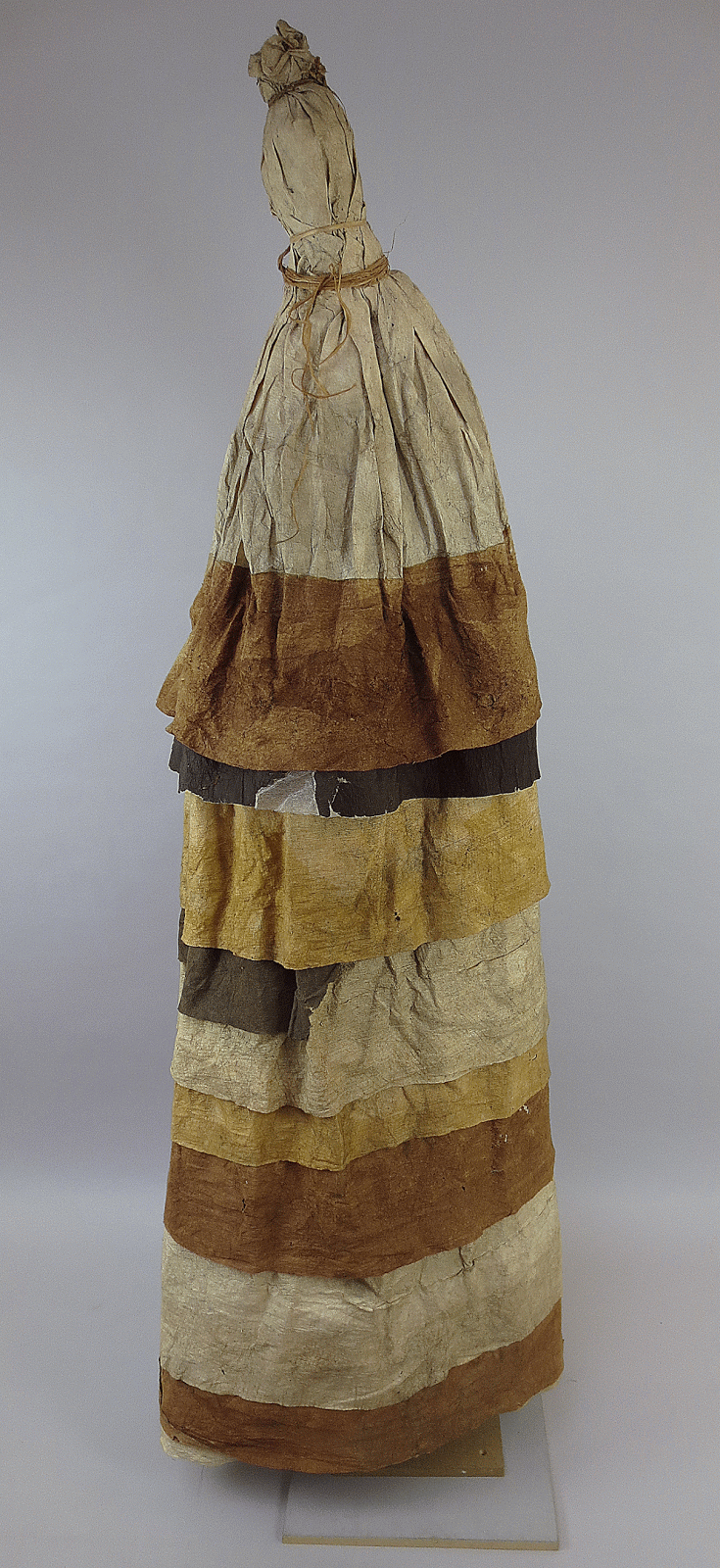
An Otahietan Fisherman's Petticoat - a new discovery


Forster 36, 1886.1.1179 - before conservation treatment

Forster number 36 in the Catalogue of Curiosities is described as 'An Otaheitian fisherman's petticoat of coloured threads/filaments of bark.'

There was an entry for it in the 'List of Anthropological objects transferred from the Ashmolean to the Pitt Rivers Museum' in 1886, where it is listed as 'A New Zealand Woaman's Apron, or Petticoat; made of narrow long strips, or rather shreds, of the inner bark of some tree ... each piece being doubled and looped over a twisted cord made of the same material, the ends of which are left long for tying. The whole has the appearance of a very deep rough fringe. Width 30 inches; Depth 2 feet. Probably Captain Cook's Collection. 1772-1774. Number lost. Given by Reinhold Forster, Esq.'

This entry was the last time it was recorded as being seen by museum staff, until last week when I found it in a box of grass clothing from Papua New Guinea.  It had been folded in half and tied tightly, hiding the Ashmolean label inside the bundle. 

Cataloguing and re-storage of the grass fibre clothing collections is part of our ongoing work to upgrade the store.  Finding 'missing' objects like this apron is just one of the benefits of carrying out this kind of work, which can be time consuming and not very glamorous! 

Comparison with similar objects in other Cook-voyage collections suggests that this skirt is indeed from Tahiti - it will be displayed with the rest of the Pitt Rivers Cook-voyage collections in mid 2015.

Monday, 1 September 2014

A Black Stripe

For the last few weeks, we've been working with Rachael Lee from the Textiles Conservation section at the Victoria and Albert Museum to help us make a mount for the Tahitian Mourner's costume.  The costume will be one of the highlights of the new display of Cook-voyage objects which will open in 2015.  The new display case which will house this exhibition is being installed this week in the Lower Gallery of the Pitt Rivers, and the re-mounted Mourner's costume will use almost the entire 2.7m height of this case. 

A few months ago, I blogged about finding a strip of barkcloth in one of our stores which I was sure was part of the Mourner's costume headdress.  Once in the lab, it was possible to confirm that this was the case - the strip was exactly the right length to fit back on the cape in the expected position.

Barkcloth strip before conservation treatment


Expected position of black strip

The barkcloth was very fragile, and couldn't be handled without damage.  It was necessary to line the strip with very fine Japanese tissue, a strong paper with long fibres, leaving a tab at the top to attach to the white barkcloth under-layer of the cape.  The adhesive used for this was a made from arrowroot and sodium alginate - it is a fairly 'dry' paste but strong enough to support the strip when hanging from the cape.  Small magnets were used to hold the barkcloth in place until the paste was dry.

Small magnets holding the tissue tab at the top of the black barkcloth strip in position

The two parts of the cape have been reunited after 120 years - one thing that is more noticeable now is the extent to which the barkcloth of the cape has faded after being on display almost continously for almost 250 years, compared with the black strip which has been in storage. 

Cape after treatment

Thursday, 5 September 2013

'A Black Piece' revisited

This post was written by Emma Schmitt from the Textile Conservation MPhil at the University of Glasgow, who is the summer conservation intern on the Conserving 'Curiosities' project.

Barkcloth 1886.1.1256

'Upon arriving at the Pitt Rivers Museum I was shown the bark cloth object on which it was assumed I would spend most of my time.  The “black piece", as it was listed in Forsters Catalogue, is an interesting and singular object in many ways.  The cloth itself is constructed of three layers, two of plain white bark cloth and one of a decorated black cloth.  The decoration, similar to that seen on the headdress of the Pitt River's second Tahitian mourner’s costume, is itself, rare in form.

1886.1.1637 .9 Headdress, Tahitian mourner's costume

Detail of barkcloth on headdress

At first glace this object is a bit scary, as you can see there are many areas of loss, but on top of that the black cloth appears to be flaking apart in some areas and powdering in others.  The painted areas easily lift up from the surface of the black bark cloth taking both the paint as well as bark fiber with it.  Every time the piece moves other small fragments are lost.


Detail of 1886.1.1256 showing surface damage

The construction of the object has had an effect on some of the damage.  The layers of this cloth have been lightly pasted together.  The black bark cloth has been pasted down in a rather haphazard manner causing creases and folds to form.  These folds can be seen in the photo and, in some places, correspond to the areas where the piece has been damaged. 

Black dyed fibers overall are susceptible to damage for one main reason.  Black dyes tend to be very high in tannin and iron and thus very acidic.  In an acidic environment the fibers can break down at the molecular level eventually leading to visible damage, like we see on this object.  For the most part black dyes in the South Pacific were made using extracts of bark, high in tannin, followed by immersion in mud that would have been high in iron.  Earlier research on this cloth shows that the black portion of the cloth is high in iron, explaining why the barkcloth was breaking down. 


1886.1.1256 - detail of surface under microscope x24

On initial examination of the painted decoration it looked as if white paint had been applied to the black cloth. However, under magnification, the paint appears to have originally been black and, for an unknown reason, appears to have bloomed with a whitish powdery substance.  The question was raised as to whether or not the paint might be a Western paint, brought on Captain Cook’s earlier voyage.  Without chemical analysis of this paint this question is difficult to answer.  The fact that the paint may be black, instead of white, means that it could easily be a local resin.  This still leaves the possibility of it being a Western paint open to speculation. 

While the investigation into the piece leaves numerous questions unanswered it posed a number of conservation issues which led to some interesting experimentation. 

As mentioned, this bark cloth is in poor condition, however it is a rare piece and thus incredibly important to the Pitt Rivers collection.  When we started to discuss possible treatments consolidation of the surface was discussed, to prevent the continuing loss of the back fiber.  Consolidation is the process by which an adhesive is applied to a surface to bind a material together to prevent further loss.  In many cases this is something down to more rigid objects like flaking or powdery painted surfaces.  In dealing with bark cloth the flexibility of the cloth is important and maintaining that flexibility is key to the treatment. 

Research into different methods of consolidation led to the work of Rangi Te Kanawa, a Maori Conservator based at The Museum of New Zealand Te Papa Tongarewa.   Ms. Te Kanawa’s work focuses on the conservation of Mari Cloaks.  Her recent research has lead to the use of sodium alginate, a seaweed based gel, as a consolidate for black dyed New Zealand flax.  Her research showed that, not only did the sodium alginate bind the deteriorating fibers together, but it also had the added benefit of neutralizing some of the acids that are the result of the mud-based dye process. 

Sodium alginate has not been applied to bark cloth by Ms. Te Kanawa so it was unknown how it would affect a very different material.  We set up an experiment to see whether or not the treatment would have a beneficial effect.  Solutions of sodium alginate were made up in various concentrations.  Using fragments of bark cloth from a store of unaccessioned samples we applied the solutions to a dry bark cloth fragment with a brush and allowed them to dry.  The result of the treatment was a metallic sheen on the surface of the bark cloth samples, reminiscent of mica, and a slight stiffening of the material.  Checking of the pH of the samples before and after treatment showed that there had been no change in the acidity of the cloth. 


Unaccessioned fragments of deteriorated barkcloth consolidated with sodium alginate solutions of varying concentrations

A second test was run to see if wetting the cloth through humidification could reduce the metallic sheen.  It was hoped that by wetting the cloth first, the sodium alginate would be drawn into the bark cloth, thus leaving less on the surface.  This treatment was successful in reducing the sheen, however, a test of the pH showed that there was still no change in the acid levels and the fabric still retained the slight stiffening see in the original tests.

Overall the experiment showed that this type of treatment may not be appropriate for bark cloth.  This may be because of the structure of the fabric as the beaten fibers lack the directionality seen in woven fabrics and thus move differently.  The lack of affect it had on the acidic pH as well as the metallic sheen and change in handle made the treatment less than ideal for “the black piece” collected by the Forsters.  An object of such importance and rarity should be treated in a way that is safe and will not visually change the object.   In the end, ‘the black piece’ had a custom-padded board and box constructed for it that will allow it to lay flat and be stored safely, in hope that in the future a treatment may be able to stabilize it and preserve it for future generations.'

Thursday, 22 August 2013

Black Drops From Tahiti

Katherine, one of the volunteers assisting with practical and research tasks in the Conserving Curiosities Project, reports on a recent exhibition in Oxford that references the voyages of Captain Cook.

Map of Tahiti by Lieut. J Cook, showing Point Venus at the top (image from the David Rumsey Map Collection)

Simon Starling’s film 'Black Drop' documents the scientific attempts to accurately record the Transit of the Venus through the past 400 years. This astronomical event, where the planet Venus passes across the disc of the sun, only happens twice every century (on a cycle just over one hundred years), with a short interval of just eight years between the first and second transit. The most recent transits were in 2004 and 2012. Starling was commissioned by Modern Art Oxford and Oxford University to record the transit in 2012 in the artist’s chosen medium of 35mm film, from the historic observation point of Hawaii. His film and two new sculptural works, Venus Mirrors (05/06/2012, Hawaii & Tahiti (Inverted)) have been exhibited at Modern Art Oxford over the summer.

By traveling to the Pacific to accurately record the planet’s movement across the sun, Starling was following in the footsteps of Captain Cook, who, as a newly appointed Lieutenant, commanded the HM Bark Endeavour on the Royal Society’s expedition to record the Venus transit of 1769. This was the year that the astronomer Jeremiah Horrocks had mathematically predicted the phenomena would occur again from his observations in the previous century. Accurate measurements of the time of the transit were desired for use in calculating the distance of the earth from the sun and therefore providing a unit of distance for measuring the universe. A skilled map draughtsman and navigator, Cook was chosen to record the transit himself alongside the astronomer, Charles Green, using the latest telescopic technology at slightly different locations in order to verify the accuracy of their recordings. Cook’s role in history of recording the Venus’ silhouette features in Starling’s film, interwoven with Starling’s own footage from 2012.

While the astronomical phenomenon can be seen from England, the sun sets in the sky before the transit is complete; a trip south to the mid-Pacific enables the planet’s complete movement to be recorded. Captain Wallis had identified the island of O-Taheitee (Tahiti) as a suitable vantage point for astronomical observations during his voyage on the HMS Dolphin between 1766-68, and so this was the destination Cook sailed towards. Upon arrival at the island, Cook chose a projection in Matavai Bay as the most suitable location to build the observatory surrounded by fortifications.


Fort Venus, site of the observatory

Although they had clear skies on the day, unfortunately the accuracy of Cook and Green’s recordings was limited by the ‘dusky haze’ that surrounded the planet making it near impossible to notice the exact time the planet first emerged and later disappeared over the edge of the sun disc. Instead, the boundaries of the planet appeared to partially bleed into the edge of the sun - the black drop effect referenced in Starling’s film title. Therefore, they were unable to provide the accurate measurements needed for further scientific calculations.

Starling traces the legacy of Cook’s ‘black drops’ in his film, interweaving the history of attempts to record the phases of the planet’s movements with the development of film technology itself. Cook was recording by eye through a telescopic lens, drawing the shape of the silhouetted planet as it met with the curved edge of sun disc in a series of sequential drawings produce on a sheet of paper. At the next transit, the following century, astronomer Pierre Jules Cesar Janssen, also sought to record sequential images of Venus to map and time its journey. Instead of drawing images seen through a telescope, Janssen developed emerging photography technology to design his own photographic revolver – a camera that took sequential photographs on a rotating disk.  Widely recognised as a precursor to cinematography, Starling draws out this relationship further by choosing film to record the 2012 transit and as the artistic medium for his historical commentary. 

However, the astronomical observations were only one part of the motivation for travelling across the Pacific in the eighteenth century. European expeditions competed in discovering and mapping new lands, resources, and other scientific discoveries. The legacy of the black drops that represented the failed goals of recording Venus has been matched by a different legacy that Cook is more well know for today: a navigator, cartographer and enlightened discoverer, and, here at the Pitt Rivers Museum, as a pioneer, alongside his crew, in establishing ethnographic collections of the material culture of people living in the Pacific in the eighteenth century.

Cook returned to the Pacific on board the HMS Resolution a few years after the Venus expedition, and it was this second voyage that the Father and son naturalists, Johann and George Forster participated in, and who later donated their significant collection of Pacific artefacts to the University of Oxford. George Forster describes the revisit to Tahiti in 1773: “We now discerned that long projecting point, which from the observation made upon it, had been named Point Venus, and easily agreed, that this was by far the most beautiful part of the island” (Forster 2000 p. 175). The Tahitians living on the island “recognised their old friends” in the returning sailors (ibid.) and a base camp was “established once more on Point Venus, for the purpose of making astronomical observations, as well as for the convenience of trading, wooding, and watering” (ibid. p. 350).

Black Drop and the accompanying sculptures are exhibited at the Modern Art Oxford until the 28th August – an except of the film can be viewed here.

Reference:

Forster, George (2000) A Voyage Round the World edited by Nicholas Thomas and Oliver Berghof, Hawaii: University of Hawaii Press


Thursday, 15 August 2013

Two Standing Figures

Wooden figures, Society Islands, 1886.1.1424 and .1423

These carved wooden figures from the Society Islands were described by the Forsters as 'Wooden representations of human figures.'  The figures, male and female, have been described in the past as 'idols', and to have been associated with the 'free standing sorcery figures' that were the abodes of inferior and sometimes malignant gods, the 'oromatua.  

It has also been suggested that the figures, known as ti'i were used as canoe prows or stern figures, since the feet are damaged, as they appear to have been attached at one time to a larger piece of wood.

1886.1.1424 Female figure

According to Hooper, in 'Pacific Encounters - Art and Divinity in Polynesia 1760-1860' (British Museum Press, 2006) the asymmetrical hand position of the female figure is very unusual in the Society Islands.  He goes on to say that 'the second-voyage ships visited several places in the group, and, given that no specific island style has yet been identified, this figure may be from an island other than Tahiti or Ra'iatea.'

Thursday, 1 August 2013

A Chance Discovery

The Pitt Rivers Museum was founded in 1884 when General Pitt Rivers, an influential figure in the development of archaeology and evolutionary anthropology, gave his collection to the University.  The ethnographic holdings of the Ashmolean were transferred to the Pitt Rivers in 1886, including the Forster collection.

Sometimes, objects, or fragments of objects, were transferred and the provenance was unknown.  Research into these is ongoing, and that's why I happened to notice a strip of barkcloth, waiting to be investigated, in one of our store rooms.  It carries the blue label which indicates that it came from the Ashmolean, and a note with it said that it has no provenance or number.

Barkcloth strip with blue Ashmolean label

On examining the strip of black-dyed, brittle barkcloth, two things struck me - that it was very similar in appearance to a strip of black barkcloth on the cape of the Tahitian Mourner's costume, largely missing, and that the remains of paste or gum along one long edge of the strip indicate that it was originally pasted onto something else, similar to the way that the differently coloured barkcloth strips are pasted onto the cape.

Remains of paste along the top edge of the strip

Closer investigation of the cape was difficult, as the Mourner's costume is currently on display in 'exploded' form.  However, we managed to take the hat and cape out of the case and examine the damaged black barkcloth stripe - there was no doubt that it was identical to the piece I had found.  Slightly puzzling was the fact that the loose strip was about 10cm too long to have been the missing part of this black stripe.

Expected position of barkcloth strip on Mourner's Costume cape

Looking at the cape, it appears that there is an entire stripe of barkcloth missing, as the pattern of stripes is broken near the top.  Lifting the remaining barkcloth strips, it's possible to see the underlying piece of barkcloth to which they are all pasted.  There, just where I had expected, were residues of a line of paste, with fibres of black barkcloth embedded in them. The length of the missing stripe corresponded  to the length of the barkcloth strip that I'd found in the store.  There is no doubt that the missing strip of barkcloth was the piece I had found, which must have been separated from the costume for over 120 years.

Actual position of barkcloth strip on cape

When the Mourner's costume is taken off of display in preparation for remounting as part of a new Cook-voyage display after the end of this project, I will reattach the strip of black barkcloth and reunite the pieces of the cape.

Thursday, 18 July 2013

'A black piece'

Emma Schmitt, a MPhil student in textile conservation, based at the Centre for Textile Conservation, Glasgow University, started at the Pitt Rivers on Monday.  She will be with us for eight weeks, working on Cook-voyage objects for the Conserving "Curiosities" project.

1886.1.1256 Barkcloth, Tahiti

Emma's first project is to investigate a piece of barkcloth, collected on Tahiti - Forster No. 18 'A black piece'. It has three layers-the bottom two are recognisably Tahitian, but the top layer, with its fish-scale like appearance, is very unusual.

Corner of barkcloth, showing deterioration

There are several questions we hope to answer about this barkcloth - why is the black layer deteriorating so badly?  What has been applied to the surface to create the dotted decoration? (There has been a suggestion that this might even be a European paint obtained on a previous voyage).


Microscope image showing detail of applied dots


Is the black barkcloth even originally from Tahiti? Emma will spend time trying to answer some of these questions, and investigating conservation treatments for the fragile barkcloth.

Friday, 28 June 2013

Photographing Barkcloth

Last week we photographed some of the large backcloths and mats from the Cook-voyage collections here at the Pitt Rivers.  This takes a bit of planning, as the only way to do it is to use the Researcher's Room, which has a light well opening into the floor above.  We can lay the barkcloth out on the floor or table, and take a photo by leaning over the railing. One barkcloth, recorded as being in three pieces, turned out to actually be a single piece, over 12m long - much too big even for that space!  Here are a few of the images, which will soon be available on the Pitt Rivers online databases, and on the new Cook-voyage collection website, currently under construction.

.
Barkcloth, Tonga  1886.1.1225


Mat, Tonga  1886.1.1172

Barkcloth, Tahiti  1886.1.1234

Barkcloth, Tahiti 1886.1.1240

Mat, Tonga 1886.1.1174


Tuesday, 18 June 2013

'A fire in the ship'

On Monday 1st August 1774, the Resolution was off the coast of Erromango, one of the islands of Vanuatu.  In 'A Voyage Round the World' George Forster described a terrifying incident as they approached the island  - 'Towards ten o'clock, we were most dreadfully alarmed by a fire in the ship.  Confusion and horror appeared in all our faces, at the bare mention of it; and it was some time before proper measures were taken to stop its progress: for in these moments of danger few are able to collect their faculties and to act with cool deliberation.  The mind which unexpected and imminent danger cannot ruffle for a time, is one of the scarcest phænomena in human nature; no wonder then, that it was not to be met among the small number of persons to to whom the ship was entrusted.  To be on board of a ship on fire, is perhaps one of the most trying situations that can be imagined; a storm itself, on a dangerous coast, is less dreadful, as it does not so entirely preclude all hopes of escaping with life.  Providentially, the fire of this day was very trifling, and extinguished in a few moments.  Our fears suggested that it was in the sail-room; but we soon found, that a piece of Taheitee cloth, carelessly laid near the lamp in the steward's room had taken fire, and raised a quantity of smoke, which gave the alarm.'

Burn marks on 1886.1.1235 (Forster No. 15)

Detail of damage to 1886.1.1235

Several pieces of barkcloth in the Forster collection have burn marks on them, which had always puzzled us.  Could the fire on board the Resolution be the reason why?  Interestingly, during a visit last week from Adrienne Kaeppler, curator of Oceanic Ethnology at the National Museum of Natural History at the Smithsonian Institution in Washington DC, a barkcloth thought possibly to be from Hawaii was identified as Tahitian, and it too has significant fire damage.   

Barkcloth 1886.1.1253.1 Showing more extensive fire damage

We are fairly sure that there are several 'lost' barkcloth pieces from the Forster collection in the Pitt Rivers museum, but since they have lost their labels, or maybe didn't ever have a unique Forster Number label (for example, Forster No. 48 in the Catalogue of Curiosities is described as 'Another parcel of Otaheitee cloth' and it is unlikely that each had a label) identification is difficult.  We can be fairly sure however that this newly discovered piece of barkcloth is part of the Forster collection - and maybe even the piece mentioned by Forster, 'carelessly laid near the lamp in the steward's room…'