Showing posts with label Mat. Show all posts

Tuesday, 19 May 2015

Tongan Mats and Barkcloth

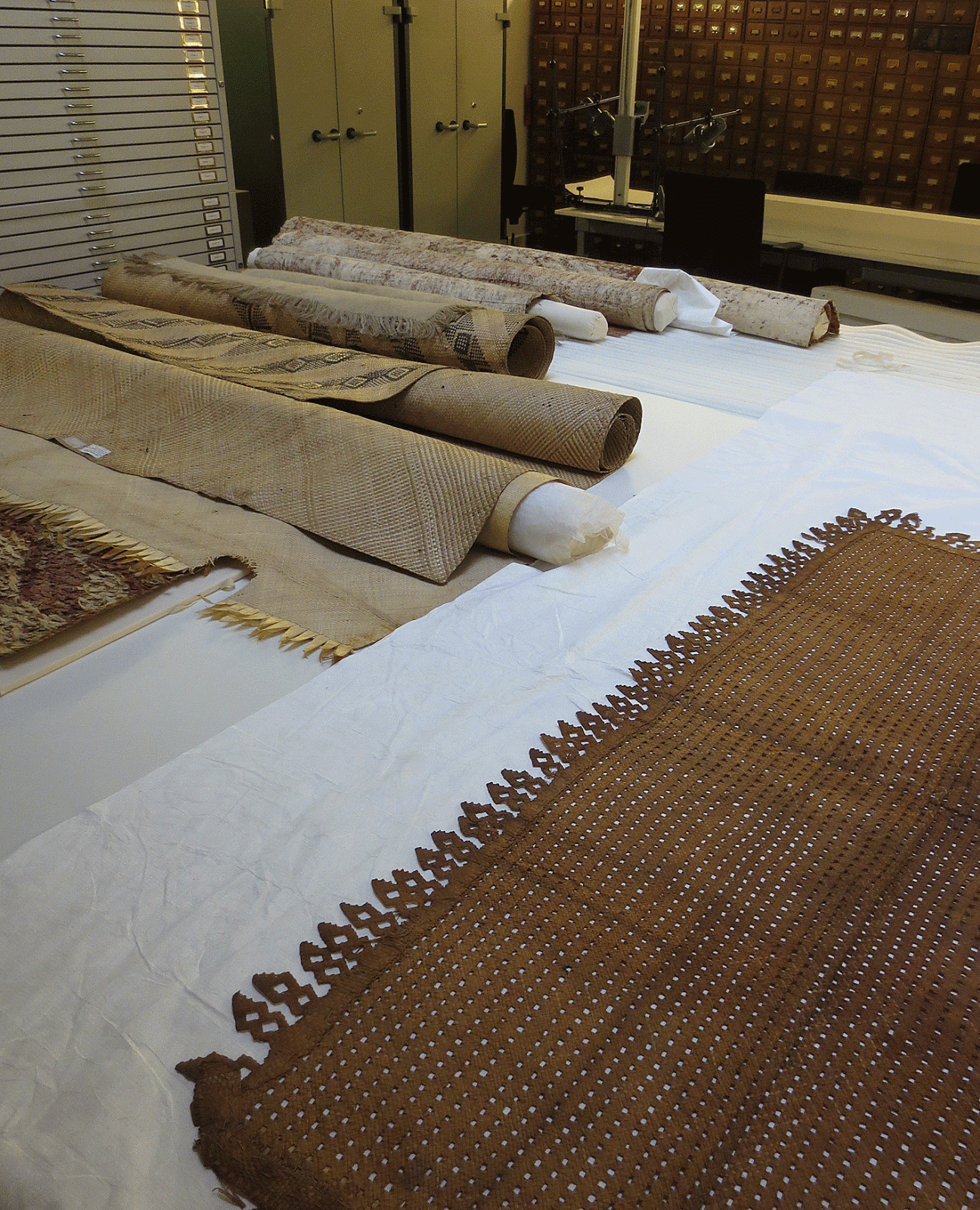
This week we've been laying out the Tongan barkcloth and mats so that the technicians can begin to prepare the mounts for the new case.


Because of the relatively large size of the barkcloth it has to be rolled for the most part.  Some of the smaller mats, and the overskirts such as the sisi fale, seen on the right in the picture below, will be more visible.

Case layout - the top of the image represents the top of the case

Tuesday, 5 May 2015

Tahitian Mat

Mounting a large mat from Tahiti to the back wall of the new case was the next challenge we faced.  We decided the answer was magnets!  Small rare earth magnets have been used to mount barkcloth and textiles for several years now.  They have the advantage that they are small, but very strong, easily powerful enough to hold a mat in place.

Applying steel tape to the board

Finished board
 
The first step was to make a board slightly smaller than the mat from zero-formaldehyde MDF.  To provide a metallic surface under the mat for the magnets to stick to, we used strips of steel tape, which were riveted to the board to make sure they stayed in place for the duration of the display. 

The magnets were covered with synthetic tissue, which had been painted with acrylics to tone into the mat.  Once in place, they are almost invisible.

Mat mounted on the wall of case mock-up

Friday, 28 June 2013

Photographing Barkcloth

Last week we photographed some of the large backcloths and mats from the Cook-voyage collections here at the Pitt Rivers.  This takes a bit of planning, as the only way to do it is to use the Researcher's Room, which has a light well opening into the floor above.  We can lay the barkcloth out on the floor or table, and take a photo by leaning over the railing. One barkcloth, recorded as being in three pieces, turned out to actually be a single piece, over 12m long - much too big even for that space!  Here are a few of the images, which will soon be available on the Pitt Rivers online databases, and on the new Cook-voyage collection website, currently under construction.

.
Barkcloth, Tonga  1886.1.1225


Mat, Tonga  1886.1.1172

Barkcloth, Tahiti  1886.1.1234

Barkcloth, Tahiti 1886.1.1240

Mat, Tonga 1886.1.1174


Wednesday, 22 May 2013

A mat from Mo'orea

1945.11.130 Mat, Mo'orea

This mat (Museum  number 1945.11.130) from Mo'orea, an island 17km NW of Tahiti, was collected by Joseph Banks on Cook's first voyage (1768-1771), and subsequently given by Banks to Christ Church, his old Oxford college. 

The mat is plaited from hibiscus bast fibres, and is unfinished.  The strips of plant material are very brittle, and unsuitable storage over the years has resulted in several large tears in one corner of the mat.

Tears in one corner of the mat

The conservation treatment on the mat began by surface cleaning using a dry, soft sponge to remove dirt residues.  This was followed by humidification using an ultrasonic humidifier to restore some moisture and strength into the plant fibres.

The tears needed to be reinforced in some way, to prevent further damage which would result in sections of the mat being torn off completely.  The material used was Japanese tissue, a type of hand-made long fibred mulberry paper.  The paper was painted to blend in with the overall colour of the mat, using powder pigments in an acrylic matte medium, and narrow strips were cut which were the same width as the strips of hibiscus bast used to make the mat.  A 'needle' was cut from thick polyester film, and a strip of tissue tacked to the end using superglue.

Weaving a strip of Japanese tissue across the tear

The strip of tissue could then be woven across the tear, using tweezers to manipulate the needle, which was then cut off.

Several strips in place

This was repeated many times, and the ends of the tissue strips were then adhered in place with a paste made from arrowroot starch, which is easily reversible in water should someone in future want to remove the paper strips.  Once one end was securely fastened, the ends strips could be gently pulled to tension then across the tear, and the other end secured with a drop of starch paste.

Treatment nearing completion

There are currently no plans to display this mat, but now it is more stable and less likely to be damaged by handling if required for study by a research visitor.

Thursday, 19 July 2012

Investigating objects

Last week, two of our project partners visited us in Oxford.  Professor Richard Evershed from the University of Bristol came with his postdoctoral student, Lucy Cramp, to take samples of resins from various objects in the Cook-voyage collections.  They will use powerful techniques such as gas chromatography, followed by mass spectroscopy to try and give more information about which plant resins were used.  These analytical techniques require very small samples, and, under the microscope, there are usually tiny loose pieces of resin which can be carefully removed using the end of a scalpel blade.

Removing a sample of resin from a chest ornament, Marquesas (1886.1.1269)

Andrew Charlton from the Food and Environment Research Agency (FERA) also came to the museum last week.  Andrew specialises in the effect of pesticides on wildlife, and the purpose of the visit was to work out a method of taking surface swabs from objects so that he can test them for pesticides residues.  We know that objects in the Pitt Rivers, as in all other museums, were routinely sprayed with pesticides, including arsenic, mercury and more recently developed chemicals such as DDT, to prevent insect attack.  We are interested in finding out if there are residues of these chemicals on the surface of museum objects.  The Cook-voyage collections have been in Oxford since the 1780s so we'd expect a wide range of pesticides to have been used on them.

Jeremy with Kloe Rumney, conservation intern from Cardiff University, taking samples from the surface of a Tongan mat (1886.1.1175)

Tuesday, 7 February 2012

A Tongan Skirt

In the last few weeks, I've been working on a Tongan skirt from the Forster Collection (1886.1.1177). The skirt is no.55a in the 'Catalogue of Curiosities', and is described as 'a matt with red stripes'.


The skirt was thought to have come from New Zealand until the Catalogue was rediscovered in 1969, which has confused the identification of the materials from which it is made.

The skirt is decorated with red and white tags made from short lengths of plant material, about 5cm long.

The red tags on the skirt, before conservation treatment

The tags have been wound around one of the strips of an outer weft where it crosses an inner one, which had to be done as the skirt was woven, leaving two 2cm long tags on the front. The tag is not visible on the inside of the skirt, and it is firmly held in place by the structure of the weaving.

Two tags, red and white, seen from the back of the skirt


Part of the 'Conserving Curiosities' project is to attempt to identify some of the plants used to make objects in the Cook-Voyage collections. Over the years there have been many suggestions about what the skirt was made from, including New Zealand flax, lacebark (a tree, also from New Zealand) and Pandanus palm. Very small pieces of the plant material from the skirt were sent to Dr Stephen Harris, Druce Curator of the Oxford Herbaria, for identification. He discovered that the skirt itself was most probably woven from the bast fibres of Thespasia populnea, a hibiscus-like plant found throughout the Pacific. Both colours of tag were identified as being made from the leaves of the Pandanus, although the leaves used to make the red tags were much more heavily processed before use, with just the outer layers of the leaf remaining. The samples were boiled in water during the identification process to rehydrate them, and Dr Harris noted that the red sample retained its colour when boiled, indicating that it was probably not dyed with a water soluble dye or pigment - interesting as the red dyes of the time were plant based and would be expected to be water soluble.

The skirt needed many hours of humidification with an ultrasonic humidifier to allow the brittle tags to be unfolded and opened up where they had become creased.

The skirt is being loaned to the Captain Cook Memorial Museum in Whitby, with several other Cook-Voyage objects from the Pitt Rivers, for their special exhibition, 'Eating the Exotic!' which opens in March.
Wednesday, 1 February 2012

Tongan Mats


There are several examples of finely woven mats from Tonga in the Cook-voyage collections at the Pitt Rivers Museum.  The mats were woven (or, technically, plaited) by women, and were used for many different purposes.  Large mats were used as sails for canoes  - a link to an article from the British Museum discussing the conservation of a unique matting sail, but from Tahiti, can be found here:
http://www.britishmuseum.org/research/online_journals/technical_research_bulletin/bmtrb_volume_3.aspx

More finely woven mats were used as clothing, and could be valuable commodities amongst the people of Tonga.  Indeed, these mats have been described as ‘the most important and powerful objects in Tonga…heirlooms passed from generation to generation as treasures…objects of prestige and power’ * They were made from the leaves of the Pandanus palm, of which there are several types.  The leaves need to be prepared for weaving by stripping off the thorny edges and the point and bleaching in the sun, or possibly in seawater, depending on the type of Pandanus. The leaves are split into strips for weaving.

The Pandanus strips used to weave the mat

Deep creases are present in the mat, a result of folding for storage
 
The mat I am currently working on is described in the ‘Catalogue of Curiosities’ as ‘No. 54  a small smooth matt’ .  It is made from Pandanus strips 2-3 mm wide, and its dimensions are approximately 168 x 132cm.

The mat has been folded for many years, so that the fold lines have become deep creases. It is possible to humidify the mat, using an ultrasonic mister, to make the creases in the mat less pronounced.

The mat is still very soft and flexible, which makes the process easier.  While working on the mat, I found an area that had been carefully repaired while the mat was in use on Tonga, showing that their owners valued these objects enough to spend the time skilfully weaving in a patch to cover the hole.


The mat partially humidified, showing the
Forster label (No.54)

The repaired area on the mat - the repair
is even less noticable on the other side

 *Kaeppler, A. ‘Kie Hingoa: Mats of Power, Rank, Prestige and History’, Journal of the Polynesian Society, Vol 108,  no.2, 1999