Showing posts with label Marquesas. Show all posts

Friday, 1 February 2013

'Two fanns from the Marquesas'

1886.1.1412 (left) and 1886.1.1411 - Two fans from the Marquesas

There are two fans from the Marquesas Islands in the Forster Collection.  Listed in the appendix of the 'Catalogue of Curiosities', they are Nos. 169 and 170 'Two fanns from the Marquesas'.  They were collected on the island of Tahuata (Sta. Christina) between the 8th and the 11th April 1774.

Detail of 1886.1.1412 showing the woven fan blade, central top section

The fans (tah'i) are woven around a wooden handle, or ke'e.  Usually, grass, pandanus leaf or the leaves and midribs of the coconut palm were used to made the blades, and they were whitened with crushed coral or lime, as reported by George Forster in 'A Voyage Round the World'.

'The weather was exceedingly hot his day, for which reason many of the inhabitants made use of large fans to cool themselves.  These fans, of which they sold us a great number, were formed of a kind of tough bark or grass, very firmly and curiously plaited, and frequently whitened with shell-lime,'

Microscopic examination of the larger fan, 1886.1.1412, showed that there were white deposits in the crevices of the basketwork.   

White deposits x20

A small sample of the deposit was taken, and tested with a drop of a dilute solution of hydrochloric acid.  Bubbles were evolved, which were probably carbon dioxide.  Whilst not conclusive proof, this strongly suggests that the deposit is a carbonate, for example calcium carbonate, from which shells are made.  
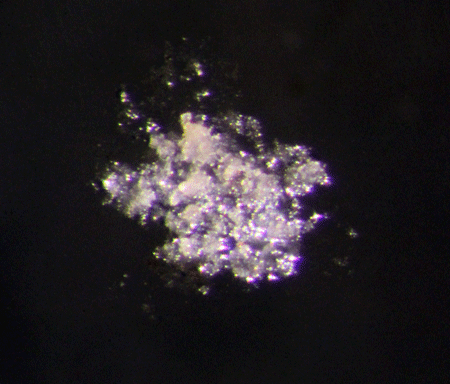
A sample of the deposit reacting with hydrochloric acid (x200)

Fans were symbols of status on the Marquesas, carried by high ranking men and women, as well as warriors (toa) and ritual specialists (tau'a).  Carol s. Ivory, in 'Adorning the World - Art of the Marquesas Islands (Metropolitan Museum of Art, 2005) writes about fans, saying that that 'displayed on important occasions, especially feasts, their visual impact was enhanced by the elegant manner with which they were carried, particularly by women.'

Patini, a high-ranking female chief, drawn on Nuku Hiva by artists from the expedition of 1838 led by Dumont d'Urville.  She holds a fan in her left hand.

Thursday, 11 October 2012

'Beautiful and noble in its kind.'

Forster 134 Mus. No. 1886.1.1340 Headdress, Marquesas

This is Forster No. 134. 'A headdress of mother of pearl & tortoise shell, with cock's feathers.'  Collected on the Marquesas in April 1774, Forster described these headdresses in 'A Voyage Round the World' - 'On their heads many of them wore a kind of diadem; this consisted of a flat bandage wrought of coco-nut core, on the outside of which several round pieces of mother of pearl, some of them five inches in diameter, were fixed, covered in the middle with a plate of tortoise-shell, perforated like fret-work. Several tufts of long, black and glossy cock's feathers formed the plumes to this head-dress, which was really beautiful and noble in its kind.' 

Image from the David Rumsey Map Collection


William Hodges, the official artist on the second voyage (1772-1775) drew a chief, Honu, from Tahuata, possibly from life on the 9th April 1774.  Forster describes the meeting - 'We went on shore after breakfast, and found our friendly natives assembled on the beach.  Among them was a chief, who was dressed in a cloak manufactured of the paper-mulberry bark, like the Tahetian cloth, and who wore the diadem, the gorget, the ear pendant, and bunches of hair. We learnt that this man was king of the whole island…'  

The diadem is known as a uhikana, the one collected by Forster being a rare double uhikana, here illustrated in the official account of the second voyage (Cook 1777, pl. XVII, fig. 4.)  


The motifs carved into the tortoiseshell overlay are seen on uhikana dating from the early contact period.  The ipu or 'container' motif is thought to represent a protective shell, such as of a turtle or crab, and to have a similar protective function for the wearer.

Thursday, 27 September 2012

'A glaring ornament'

Forster No.133 Mus. No. 1886.1.1269

This breast ornament was collected on Tahuata in the Marquesas in April 1774.  Forster, in 'A Voyage Round the World' describes this 'glaring ornament', saying that 'their leaders wore a kind of gorget around the neck, or rather on the breast; it consisted of small portions of a light wood, like cork, glued together with gum, in a semicircular form; a quantity of scarlet beans (abrus precatorius, LInn.) are glued all round it with the same gum, forming a great number of rows, of the length of two or three inches.'

The gorget, known as a tahi poniu, is made up of seventeen sections of wood.  The red and black abrus seeds have been set in a thick layer of brittle brown resin, said to be gum from the breadfruit tree.

Microscope image of gum

As part of this project, samples of the gum were taken and will be analysed by scientists at the University of Bristol.

Sampling from 1886.1.1269

The gorget is missing quite a few seeds - even in 1884 when the collection was transferred from the Ashmolean Museum it was noted that 'many of the berries have come off this ornament and have been stuck from time to time with glue and many are wanting,particularly from the back edge.'  The back of the gorget has been extensively repaired, with new sections of plywood added to replace missing or damaged areas.  This was done before conservation records were kept.

The back of the gorget.  Replacement plywood rays can be seen near the top of the image.

Friday, 21 September 2012

'A bunch of hair'

George Forster, in 'A Voyage Round the World' wrote at length on the 'ornaments' worn by the Marquesans.  He notes that 'they were also fond of having bunches of human hair tied on a string round their waist, arms, knees and ancles (sic).  All these ornaments they freely parted with for a trifling consideration, except the last, which they valued very highly, though they were the usual residence of many vermin.  It is probably that these bunches of hair were worn in remembrance of their dead relations and therefore looked upon with some veneration; or else they may be  the spoils of their enemies, worn as the honourable testimonies of victory.  However a large nail or something which struck their eyes, commonly got the better of their scruples.'

1886.1.1267 Hair ornament, Marquesas

This is number 137 in the 'Catalogue of Curiosities' - 'A bunch of hair, tied on the arms, knees or ancles'.  It was collected at Vaitahu, on the island of Tahuata, as were all the Marquesan objects in the Forster collection.  

Hardy, in 'The Native Culture in the Marquesas' (Bernice P. Bishop Museum Bulletin No. 9, 1923) identifies these hair ornaments as ouoho (literally head-hair).  They were worn by males and females, and the hair was usually that of relatives, although the hair of enemies was sometimes used. The hair was taken to a tuhuna hana titi ouoho (specialist) who wrapped it on small sticks, bound the rolls with leaves and baked them in an oven of heated stones.  The hair was then bound into bundles and attached to a braided coconut fibre cord.  

Shiny consolidant is visible at the base of the hair bundles

The hair ornament in the Pitt Rivers collection has been treated in the past to consolidate the brittle hair.  We have no records of the treatment, which was probably carried out before 1970, when the conservation department was started.  The consolidant is now brittle and shiny, and cannot be removed without damaging the hair further.

Friday, 14 September 2012

'In the shape of a large tooth'

Europeans first encountered the Marquesas in 1595, when the Spanish Explorer Alvaro de Mendana de Neira named them Las Islas de Marquesa de Mendoza and claimed them for Spain.  The next European visitor was Cook, who arrived at the beginning of April 1774.  Cook anchored for several days at Vaitahu, on Tahuata, in the same harbour used by Mendana.

George Forster, in 'A Voyage Round the World' notes that the inhabitants 'looked almost black, being punctured (tattooed) over the whole body.'  Some of them, once they had sold their fruit and vegetables to the sailors on board the Resolution, 'came on board to be gazed at, and to gaze.' Forster also described the many ornaments worn by the Marquesans, observing that 'the number of ornaments, in some measure, might be said to supply the want of clothing.' He went on to say that some 'wore a string around the neck, and fastened to it a piece of shell, which was cut and polished in the shape of a large tooth.' (See George Forster, 'A Voyage Round the World', N.Thomas and O. Berghof (Eds) Vol.1. University of Hawaii Press, Honolulu, 2000).

There are two of these shell ornaments in the Cook-voyage collections at the Pitt Rivers, collected by the Forsters.  In the 'Catalogue of Curiosities' they are numbers 139 and 140, 'Two bones (or teeth of porpoises?) hung before the neck.'

1886.1.1540 (left) and 1886.1.1541 (right)

The pendants are made from shell, probably from the mouth of a helmet shell (Cassidae sp.) They are carved to resemble whales teeth, which were a valuable commodity on the Marquesas, and reserved only for those of high status.  The Marquesas had few fringing reefs, and few sperm whales were stranded there, as occurred elsewhere in Polynesia.  The fact that shell was carved to resemble whale teeth (skeuomorphs - objects made from one material in the form of another) shows how important whale ivory was to the Marquesans.  The cord is made from strands of barkcloth, which have been twisted together.

See also Steven Hooper, 'Pacific Encounters, Art and Divinity in Polynesia 1760-1860' British Museum Press, 2006, and Eric Kjellgren with Carol S. Ivory, 'Adorning the World - Art of the Marquesas Islands', Metropolitan Museum of Art, 2005.

Thursday, 19 July 2012

Investigating objects

Last week, two of our project partners visited us in Oxford.  Professor Richard Evershed from the University of Bristol came with his postdoctoral student, Lucy Cramp, to take samples of resins from various objects in the Cook-voyage collections.  They will use powerful techniques such as gas chromatography, followed by mass spectroscopy to try and give more information about which plant resins were used.  These analytical techniques require very small samples, and, under the microscope, there are usually tiny loose pieces of resin which can be carefully removed using the end of a scalpel blade.

Removing a sample of resin from a chest ornament, Marquesas (1886.1.1269)

Andrew Charlton from the Food and Environment Research Agency (FERA) also came to the museum last week.  Andrew specialises in the effect of pesticides on wildlife, and the purpose of the visit was to work out a method of taking surface swabs from objects so that he can test them for pesticides residues.  We know that objects in the Pitt Rivers, as in all other museums, were routinely sprayed with pesticides, including arsenic, mercury and more recently developed chemicals such as DDT, to prevent insect attack.  We are interested in finding out if there are residues of these chemicals on the surface of museum objects.  The Cook-voyage collections have been in Oxford since the 1780s so we'd expect a wide range of pesticides to have been used on them.

Jeremy with Kloe Rumney, conservation intern from Cardiff University, taking samples from the surface of a Tongan mat (1886.1.1175)