Showing posts with label Coconut. Show all posts

Friday, 1 February 2013

'Two fanns from the Marquesas'

1886.1.1412 (left) and 1886.1.1411 - Two fans from the Marquesas

There are two fans from the Marquesas Islands in the Forster Collection.  Listed in the appendix of the 'Catalogue of Curiosities', they are Nos. 169 and 170 'Two fanns from the Marquesas'.  They were collected on the island of Tahuata (Sta. Christina) between the 8th and the 11th April 1774.

Detail of 1886.1.1412 showing the woven fan blade, central top section

The fans (tah'i) are woven around a wooden handle, or ke'e.  Usually, grass, pandanus leaf or the leaves and midribs of the coconut palm were used to made the blades, and they were whitened with crushed coral or lime, as reported by George Forster in 'A Voyage Round the World'.

'The weather was exceedingly hot his day, for which reason many of the inhabitants made use of large fans to cool themselves.  These fans, of which they sold us a great number, were formed of a kind of tough bark or grass, very firmly and curiously plaited, and frequently whitened with shell-lime,'

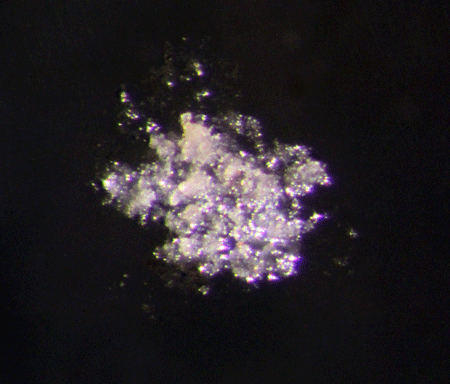
Microscopic examination of the larger fan, 1886.1.1412, showed that there were white deposits in the crevices of the basketwork.   

White deposits x20

A small sample of the deposit was taken, and tested with a drop of a dilute solution of hydrochloric acid.  Bubbles were evolved, which were probably carbon dioxide.  Whilst not conclusive proof, this strongly suggests that the deposit is a carbonate, for example calcium carbonate, from which shells are made.  

A sample of the deposit reacting with hydrochloric acid (x200)

Fans were symbols of status on the Marquesas, carried by high ranking men and women, as well as warriors (toa) and ritual specialists (tau'a).  Carol s. Ivory, in 'Adorning the World - Art of the Marquesas Islands (Metropolitan Museum of Art, 2005) writes about fans, saying that that 'displayed on important occasions, especially feasts, their visual impact was enhanced by the elegant manner with which they were carried, particularly by women.'

Patini, a high-ranking female chief, drawn on Nuku Hiva by artists from the expedition of 1838 led by Dumont d'Urville.  She holds a fan in her left hand.

Friday, 25 January 2013

'A breast-plate or war gorget'

1887.1.392 Taumi or Gorget, Tahiti

This Tahitian breastplate or taumi was collected on Cook's first voyage.  It was part of the collection of thirty objects given by Joseph Banks to Christ Church, his old Oxford college.

Taumi were worn by high ranking warriors, and they may have been worn in pairs, one on the front and one on the back - an illustration by John Webber shows a girl bringing a large roll of barkcloth 'as a present', to which are attached two taumi, suggesting that they may have belonged in pairs.  

'A young woman of Otaheite bringing a present' John Webber

Roger Rose, in 'Taumi Gorgets from the Society Islands' (in 'Artistic Heritage in a Changing Pacific', University of Hawaii Press, 1993) suggests that professional warriors on Tahiti, 'aito or toa, who achieved their position through valour, but who were also members of the elite ari'i class of society, or of the slightly lower rank of ra-atira, were eligible to wear the taumi in battle.  It is possible that the taumi represented the jaws of a shark, giving the wearer shark-like qualities.

The taumi is made from strips plaited coconut fibre, supported by a grid of ie'ie (Freycinetia sp.) aerial root which has been tied together with coconut fibre.   

1887.1.392 - back showing framework of ie'ie aerial root

The gorget is decorated with rows of pigeon feathers, interspersed with rows of sharks' teeth, possibly from the oceanic whitetip shark (Carcharinus longimanus).  It has been suggested that it is possible to obtain only about ten or twelve matching teeth from a shark - there are 130 teeth on the gorget, so this represents a resource of considerable value.   

Detail of shark teeth

The gorget is fringed with dog hair, again a rare and precious resource.   

Detail of dog hair holders

The hair is bound into 'hair holders' bound with coconut fibre.  It is possible that the dog hair was traded for from the Tuamotu Islands.  Johann Reinhold Forster, in 'Observations Made During A Voyage Round the World' notes that 'the whole gorget is fringed with long white dogs hair, imported from the Low Isles (Tuamotus) to O-Tahietee, and the Society Isles'.  

He also observed that 'The Low-Islands have a race of dogs with long white hair, which the natives employ in fringing their breastplates or war gorgets; and these low islanders cannot cultivate the mulberry tree on their sandy, barren ledges of lands, which includes their salt lagoons; therefore the these reciprocal wants, form a kind of commerce between the inhabitants of the high and low islands, and a mutual exchange of superfluities.’   

This idea of trading links between Tahiti and the Tuamotu Islands seems to be confirmed by a group of dog-hair holders, strung onto coconut fibre cord for storage or transport, in the British Museum (LMS210).  These were possibly from Ana’a Island in the Tuamotus.  
 
In 'Footprints in the Sand: Banks's Maori Collection, Cook's First Voyage 1768-71', by Paul Tapsell, (in Discovering Cook's Collections, edited by Michelle Hetherington and Howard Morphy (Canberra: National Museum of Australia, 2009), the possibility is raised that this object may have been a personal possession of Tupaia (Tupaea in Maori).  Tupaia was a high ranking priest taken on board the Endeavour on Tahiti as a navigational guide. Tupaia's belongings may have been appropriated by Joseph Banks after Tupaia's death in Batavia in 1770. Tapsell writes: 'So what happened to Tupaea's belongings, the taonga, after his death? Surely a high priest of ariki status would have had his own personal ornaments? Perhaps the chiefly breast ornament [1887.1.392] and flute [1903.130.20] now properly attributed as part of Banks's Christ Church collection were originally Tupaea's personal possessions.'

Thursday, 11 October 2012

'Beautiful and noble in its kind.'

Forster 134 Mus. No. 1886.1.1340 Headdress, Marquesas

This is Forster No. 134. 'A headdress of mother of pearl & tortoise shell, with cock's feathers.'  Collected on the Marquesas in April 1774, Forster described these headdresses in 'A Voyage Round the World' - 'On their heads many of them wore a kind of diadem; this consisted of a flat bandage wrought of coco-nut core, on the outside of which several round pieces of mother of pearl, some of them five inches in diameter, were fixed, covered in the middle with a plate of tortoise-shell, perforated like fret-work. Several tufts of long, black and glossy cock's feathers formed the plumes to this head-dress, which was really beautiful and noble in its kind.' 

Image from the David Rumsey Map Collection


William Hodges, the official artist on the second voyage (1772-1775) drew a chief, Honu, from Tahuata, possibly from life on the 9th April 1774.  Forster describes the meeting - 'We went on shore after breakfast, and found our friendly natives assembled on the beach.  Among them was a chief, who was dressed in a cloak manufactured of the paper-mulberry bark, like the Tahetian cloth, and who wore the diadem, the gorget, the ear pendant, and bunches of hair. We learnt that this man was king of the whole island…'  

The diadem is known as a uhikana, the one collected by Forster being a rare double uhikana, here illustrated in the official account of the second voyage (Cook 1777, pl. XVII, fig. 4.)  


The motifs carved into the tortoiseshell overlay are seen on uhikana dating from the early contact period.  The ipu or 'container' motif is thought to represent a protective shell, such as of a turtle or crab, and to have a similar protective function for the wearer.

Friday, 21 September 2012

'A bunch of hair'

George Forster, in 'A Voyage Round the World' wrote at length on the 'ornaments' worn by the Marquesans.  He notes that 'they were also fond of having bunches of human hair tied on a string round their waist, arms, knees and ancles (sic).  All these ornaments they freely parted with for a trifling consideration, except the last, which they valued very highly, though they were the usual residence of many vermin.  It is probably that these bunches of hair were worn in remembrance of their dead relations and therefore looked upon with some veneration; or else they may be  the spoils of their enemies, worn as the honourable testimonies of victory.  However a large nail or something which struck their eyes, commonly got the better of their scruples.'

1886.1.1267 Hair ornament, Marquesas

This is number 137 in the 'Catalogue of Curiosities' - 'A bunch of hair, tied on the arms, knees or ancles'.  It was collected at Vaitahu, on the island of Tahuata, as were all the Marquesan objects in the Forster collection.  

Hardy, in 'The Native Culture in the Marquesas' (Bernice P. Bishop Museum Bulletin No. 9, 1923) identifies these hair ornaments as ouoho (literally head-hair).  They were worn by males and females, and the hair was usually that of relatives, although the hair of enemies was sometimes used. The hair was taken to a tuhuna hana titi ouoho (specialist) who wrapped it on small sticks, bound the rolls with leaves and baked them in an oven of heated stones.  The hair was then bound into bundles and attached to a braided coconut fibre cord.  

Shiny consolidant is visible at the base of the hair bundles

The hair ornament in the Pitt Rivers collection has been treated in the past to consolidate the brittle hair.  We have no records of the treatment, which was probably carried out before 1970, when the conservation department was started.  The consolidant is now brittle and shiny, and cannot be removed without damaging the hair further.

Monday, 16 July 2012

The conservation of a kato alu basket

Some of the objects in the Cook-voyage collections of the Pitt Rivers Museum need interventive conservation work, to stabilise them for display or research.  The Tongan baskets which I've talked about in previous posts are examples of this.  The kato alu in particular has been badly crushed in the past, and the palm leaf midribs that make up the framework of the basket have been broken.  The basket has also become distorted, making any repairs even more difficult to achieve.

Discussing the treatment of the Tongan baskets

Before undertaking a treatment, the conservators at the Pitt Rivers often discuss the options. Sometimes, the general feeling might be that an interventive treatment is not necessary, and that with careful packing and handling further damage to an object can be avoided.  Sometimes though, as with the kato alu, something needs to be done to stabilise damaged areas. 

There were two stages to the conservation treatment of this basket.  The first was to attempt to re-shape it, bringing the broken areas back into alignment.  This was done by making an internal support which allowed the basket to rest upside down.  The basket was then humidified, by placing it in a humidity chamber made from polythene and introducing water vapour, produced by an ultrasonic mister. This uses a metal diaphragm vibrating at ultrasonic frequencies to generate very fine water droplets at room temperature.

The kato alu basket, 1886.1.1328 in the humidity chamber

The vapour is absorbed by the plant material, making it more flexible and easier to manipulate.  The basket was left in the humidity chamber for an hour, and was then flexible enough to reshape gently, holding the new position with pieces of foam tied around the basket with cotton tape.

Reshaping the basket


The basket will be humidified several more times, and the foam adjusted until it has reached a shape more similar to the original.  The breaks in the kato alu will be secured on the inside of the basket with strips of Japanese paper, tinted with acrylic paint to tone in with the colour of the basketwork.  In this way, the broken edges will be protected, and the possibility of future damage or losses reduced.

Friday, 6 July 2012

'Elegant in the Highest Degree'

George Forster notes in 'A Voyage Round the World' in his entries for October 1773 that on Tonga 'these (coconut) fibres were likewise employed in making a great variety of baskets, wrought with regular compartments of two colours, brown and black, or sometimes all brown, and ornamented with rows of flat beads, which were made by cutting bits of shell into that shape.  The taste and the workmanship of these baskets was elegant in the highest degree, and varied into different forms and patterns.' 

1886.1.1330 Kaki mosi kaka, Tonga

This basket, a kaki mosi kaka, is made from dyed and undyed fibres from the coconut husk, leaf sheaths or roots (kaka).  Single strands of the fibre are twined in double pairs to create a very flexible flat basket, said to have been used by chiefly ladies to carry pieces of barkcloth impregnated with scented coconut oil.  The manufacture of baskets of this type ceased in the middle of the 19th century.

1886.1.1130 Detail

The design on the basket, of black and brown triangles, is known as manulua, two birds flying together.  It is a genealogical metaphor for a high-ranking person whose parentage is equally high on both sides.

The basket is made from a single layer of fibre, and is still very flexible,  However some damage has occurred around the handles.  Careful handling and storage should however mean that no interventive conservation treatment is required, apart from surface cleaning.

1886.1.1330 detail of fibre and beads (top-shell, bottom, coconut)