Showing posts with label Plant fibres. Show all posts

Thursday, 20 November 2014

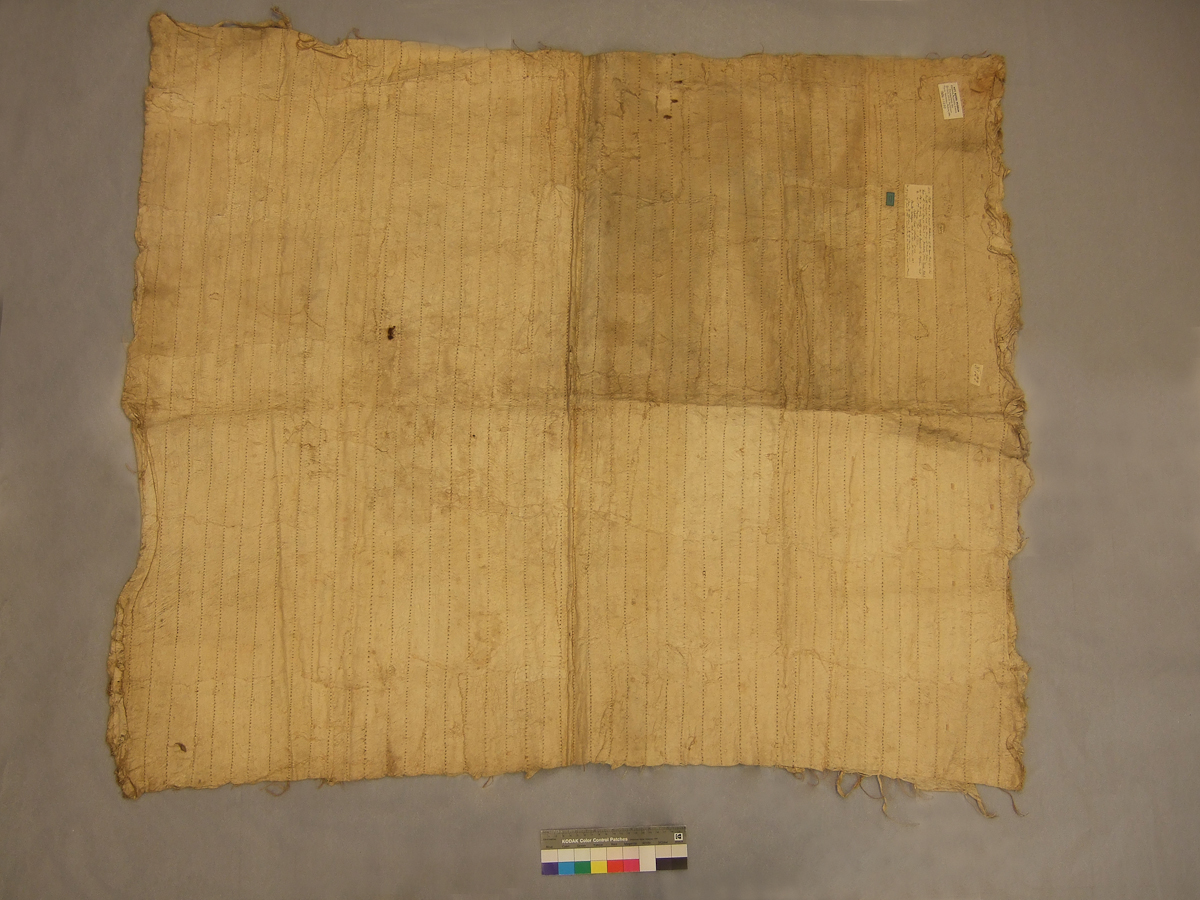
An Otahietan Fisherman's Petticoat - a new discovery


Forster 36, 1886.1.1179 - before conservation treatment

Forster number 36 in the Catalogue of Curiosities is described as 'An Otaheitian fisherman's petticoat of coloured threads/filaments of bark.'

There was an entry for it in the 'List of Anthropological objects transferred from the Ashmolean to the Pitt Rivers Museum' in 1886, where it is listed as 'A New Zealand Woaman's Apron, or Petticoat; made of narrow long strips, or rather shreds, of the inner bark of some tree ... each piece being doubled and looped over a twisted cord made of the same material, the ends of which are left long for tying. The whole has the appearance of a very deep rough fringe. Width 30 inches; Depth 2 feet. Probably Captain Cook's Collection. 1772-1774. Number lost. Given by Reinhold Forster, Esq.'

This entry was the last time it was recorded as being seen by museum staff, until last week when I found it in a box of grass clothing from Papua New Guinea.  It had been folded in half and tied tightly, hiding the Ashmolean label inside the bundle. 

Cataloguing and re-storage of the grass fibre clothing collections is part of our ongoing work to upgrade the store.  Finding 'missing' objects like this apron is just one of the benefits of carrying out this kind of work, which can be time consuming and not very glamorous! 

Comparison with similar objects in other Cook-voyage collections suggests that this skirt is indeed from Tahiti - it will be displayed with the rest of the Pitt Rivers Cook-voyage collections in mid 2015.

Monday, 17 December 2012

Plant Identification, and a 'fine and beautiful braid of human hair'

Last week, Caroline Cartwright from the Department of Conservation and Scientific Research at the British Museum came to visit us at the Pitt Rivers.  Caroline is an expert in the identification of plant fibres, and she will be carrying out some ID work for the Conserving 'Curiosities' project.  

In a previous blog post I mentioned that the investigation of the materials from which objects are made can give us information about where they come from - even though the Forster collection in particular is relatively well documented, there is still confusion about this.  Even when we know for sure where an object comes from, like this unique barkcloth from Easter Island (Rapa Nui), some of the materials still remain unidentified.  

1886.1.1250 Barkcloth, Easter Island

The barkcloth has decorative bands of plant material sewn across each end - said to be a rush that grows in the bottom of the extinct volcano (Rano Kau) on Easter Island.  A cord made from plant fibre was used to sew the layers of barkcloth together at intervals - almost like quilting.  

1886.1.1250 Detail of stitching and fibre
  
Other material that Caroline will look at includes plant fragments found in this headdress.  

1886.1.1685 Tamau Headdress, Tahiti

This is Forster No. 40, 'The Tamow, or headdress of plaited hair.'  Considered to be a 'lost' Forster object, it was found under the bindings of the Tahitian Mourner's costume.  

The tamau as found on the headdress of the Mourner's costume

The tamau was made of many metres of plaited human hair, made to form a continuous length.  It was worn by women as they danced, and the centre was filled with flowers.  

A young woman of Otaheite Dancing, after John Webber

George Forster, in 'A Voyage Round the World', saw a dance performance in the Society Islands in September 1773. He talks about the dress of the dancers, which included 'Poyadua (Poedua), the fair daughter of the chief Orea'…

'The neck, shoulders and arms were left uncovered, but the head was ornamented with a kind of turban, about eight inches high, made of several skains of plaited human hair, which they call tamow.  These being laid above each other in circles, which enlarged towards the top, there was a deep hollow left in the middle, which they had filled up with a great quantity of the sweet-scented flowers of the (gardenia) cape jasmine.  But all the front of the turban was ornamented with three or four rows of a small white flower, which formed little stars, and had as elegant an effect on the jetty black hair as if it had been set with pearls.'

William Ellis also described a group of dancers on Tahiti in 'Polynesian Researches', published in 1831.

'The daughters of the chiefs, who were the dancers on these occasions, at times amounted to five or six, though occasionally only one exhibited her symmetry of figure, and gracefulness of action.  Their dress was singular, but elegant.  The head was ornamented with tamau, a fine and beautiful braid of human hair, wound around the head in the form of a turban. *  A triple wreath of scarlet, white and yellow flowers, composed of the aute, the fragrant gardenia, or Cape jessamine, and the baslaria laurifolia, tastefully interwoven, adorned the curious head-dress.

* Mr Barff, to whom I am indebted for the principal part of this account, procured a head-dress of this kind, containing one hundred fathoms of the finest braided human hair.'  

One hundred fathoms is about 180m.  It is likely that the tamau in the Pitt Rivers collection contains closer to 1000m of hair.  

Fragments of plant material were taken from this and several other objects, and we hope that with Caroline's help some of the questions that people have been asking about the Cook-voyage collections for several hundred years might finally be answered. 

Friday, 19 October 2012

Investigating Plant Fibres

A part of this project to conserve and investigate the Cook-voyage collections at the Pitt Rivers Museum is to attempt to identify the materials from which the objects are made.  Knowing what artefacts are made from can help us find out where they were collected.  Although the Catalogue of Curiosities gives us fairly good information about this, sometimes there is still confusion, as in entry No. 98. 'Nine different kinds of necklaces; together with three mother of pearl shells which hang on the breast.'  Although this entry appears in the section entitled 'The Friendly Isles' (Tonga) not all of the necklaces come from there - some, in fact, were thought to be from New Zealand. 

Information about materials comes from various sources - the Forsters sometimes mention what the objects they collected were made from.  Curators and researchers have added information over the years - but sometimes materials are very similar and only close observation under the microscope can distinguish them.  Plant fibres come into this category, which brings me back to the nine necklaces which are part of Forster No. 98.  

Nine necklaces, part of Forster No. 98

The necklaces are all made from beads of various kinds, threaded on cords made from vegetable fibre.  If the necklace is from New Zealand, the fibre will probably be from New Zealand flax (Phormium tenax - harakeke).  This plant did not grow on Tonga in the Eighteenth century - the Tongans used a plant in the nettle family, Pipturus argenteus (olonga) to make a fine cord, also used in the manufacture of fish hooks and nets.   

Samples consisting of a single fragment of fibre were taken from the cords of all of the necklaces.  The samples were dehydrated in ethanol, and then washed in toluene before being mounted on slides in Numount, a synthetic mounting medium intended as a replacement for Canada Balsam.   The samples need to be washed in toluene, which is the solvent for Numount, because ethanol would make the Numount go cloudy.  
  
Samples of loose fibres were taken from several Maori objects in the Cook-voyage collections, as examples of aged New Zealand flax fibres, and also from Tongan fishing hooks and a fishing net - likely to be samples of olonga.  

New Zealand flax fibres, x100

New Zealand flax fibres, x400

Comparison of the 'known' samples under the microscope, using crossed polars showed the the two fibres are quite distinct - the olonga fibre in particular has characteristic diagonal lines on the surface which may be a result of varying thicknesses within the cell wall. 


Olonga fibres, x100
Olonga fibres, x400

The samples taken from the necklaces could then be compared with the 'known' fibres.  The cords of those considered stylistically to come from Tonga were all made from olonga fibre, and those thought to come from New Zealand were made from harakeke.  One necklace was the subject of debate, but the fibre proved to be olonga, suggesting that it came from Tonga.

Fibres from necklace 1886.1.1575, x100

Fibres from 1886.1.1575, x400