Monday, 17 December 2012

Plant Identification, and a 'fine and beautiful braid of human hair'

Last week, Caroline Cartwright from the Department of Conservation and Scientific Research at the British Museum came to visit us at the Pitt Rivers.  Caroline is an expert in the identification of plant fibres, and she will be carrying out some ID work for the Conserving 'Curiosities' project.  

In a previous blog post I mentioned that the investigation of the materials from which objects are made can give us information about where they come from - even though the Forster collection in particular is relatively well documented, there is still confusion about this.  Even when we know for sure where an object comes from, like this unique barkcloth from Easter Island (Rapa Nui), some of the materials still remain unidentified.  
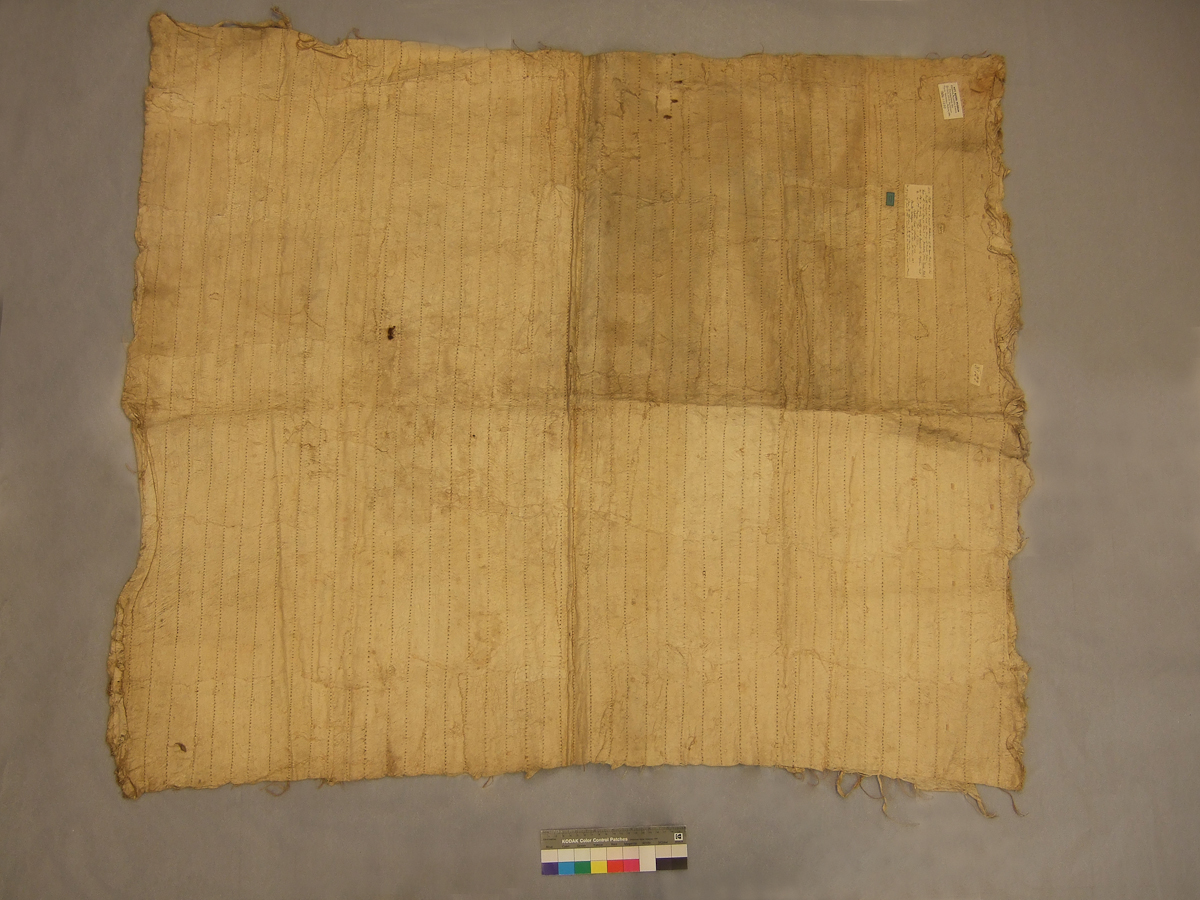
1886.1.1250 Barkcloth, Easter Island

The barkcloth has decorative bands of plant material sewn across each end - said to be a rush that grows in the bottom of the extinct volcano (Rano Kau) on Easter Island.  A cord made from plant fibre was used to sew the layers of barkcloth together at intervals - almost like quilting.  

1886.1.1250 Detail of stitching and fibre
  
Other material that Caroline will look at includes plant fragments found in this headdress.  

1886.1.1685 Tamau Headdress, Tahiti

This is Forster No. 40, 'The Tamow, or headdress of plaited hair.'  Considered to be a 'lost' Forster object, it was found under the bindings of the Tahitian Mourner's costume.  

The tamau as found on the headdress of the Mourner's costume

The tamau was made of many metres of plaited human hair, made to form a continuous length.  It was worn by women as they danced, and the centre was filled with flowers.  

A young woman of Otaheite Dancing, after John Webber

George Forster, in 'A Voyage Round the World', saw a dance performance in the Society Islands in September 1773. He talks about the dress of the dancers, which included 'Poyadua (Poedua), the fair daughter of the chief Orea'…

'The neck, shoulders and arms were left uncovered, but the head was ornamented with a kind of turban, about eight inches high, made of several skains of plaited human hair, which they call tamow.  These being laid above each other in circles, which enlarged towards the top, there was a deep hollow left in the middle, which they had filled up with a great quantity of the sweet-scented flowers of the (gardenia) cape jasmine.  But all the front of the turban was ornamented with three or four rows of a small white flower, which formed little stars, and had as elegant an effect on the jetty black hair as if it had been set with pearls.'

William Ellis also described a group of dancers on Tahiti in 'Polynesian Researches', published in 1831.

'The daughters of the chiefs, who were the dancers on these occasions, at times amounted to five or six, though occasionally only one exhibited her symmetry of figure, and gracefulness of action.  Their dress was singular, but elegant.  The head was ornamented with tamau, a fine and beautiful braid of human hair, wound around the head in the form of a turban. *  A triple wreath of scarlet, white and yellow flowers, composed of the aute, the fragrant gardenia, or Cape jessamine, and the baslaria laurifolia, tastefully interwoven, adorned the curious head-dress.

* Mr Barff, to whom I am indebted for the principal part of this account, procured a head-dress of this kind, containing one hundred fathoms of the finest braided human hair.'  

One hundred fathoms is about 180m.  It is likely that the tamau in the Pitt Rivers collection contains closer to 1000m of hair.  

Fragments of plant material were taken from this and several other objects, and we hope that with Caroline's help some of the questions that people have been asking about the Cook-voyage collections for several hundred years might finally be answered. 

Thursday, 6 December 2012

Pesticides on Museum Objects

Part of the Cook-Voyage project at the Pitt Rivers is to look at the question of pesticide residues on objects from the collections.  Chemicals have always been applied to objects in museum collections to protect them from pests, mainly insects, which can cause a lot of damage. 

As the Forster Collection has been in Oxford since 1776, and the Banks collection was at Christchurch even before that, the Cook-voyage collections potentially span virtually the whole history of pesticide use in museums.  Even though we know that chemicals such as arsenic, mercury and DDT, were routinely applied to museum collections, finding evidence of what was actually done is difficult.  

Label from a poncho from the Tahitian Mourner's costume, giving information on the condition of the feather cape.

A label on the Tahitian Mourner's costume, written just before the Ashmolean's ethnographic holdings were transferred to the Pitt Rivers in 1886, records that the cloak was 'now in a very bad condition' and an entry in the Accession Registers goes on to say that this was 'through the moth, and (it) has been removed to the Museum in the Parks (Oxford University Natural History Museum) and placed under the charge of Professor Moseley to be fumigated.'  We don't know, however, what fumigation involved. 

Sometimes, the Pitt Rivers annual reports give us more of a clue.  In 1946-47, the Curator, T.K. Penniman, wrote that 'we have tried the Clymax spray on all of our material, and have found it thoroughly effective in destroying every sort of pest that attacks every sort of material that human beings use.'  Powerful stuff indeed!  There is also a mention of a fumigation chamber being built so that methyl bromide gas could be used to kill pest infestations on museum objects, but it is not clear whether this was ever actually used.  

Jeremy Uden and Kloe Rumsey, conservation intern, taking samples of surface deposits from a Tongan mat.
  
The analysis of pesticide residues is being done for us by Andrew Charlton, an analytical chemist at the Wildlife Incident Unit, part of the Food and Environment Research Agency.  He usually works on investigating pesticide uptake by wildlife, especially honey bees.  The samples he works on are usually destroyed during the analysis - not something that is practical for museum objects.  We are using cotton wool swabs dampened with distilled water to take samples of the surface dirt and residues from objects - we know that the object is not damaged in the process, which is of paramount importance, but we have to accept that we may not be able to get large amounts of any residues remaining on the surface onto the swabs. 

Once Andrew receives the swabs, any residues on them are extracted with an organic solvent for analysis using gas chromatography - mass spectrometry (GC-MS), a highly sensitive technique which can detect parts per billion (ppb) levels of target pesticides.  Each target pesticide is detected in the mass spectrometer by the presence of characteristic molecular fragments providing a unique ‘fingerprint’.  To detect the presence of arsenic or mercury compounds, swabs are extracted with dilute acid for elemental analysis by inductively coupled plasma - mass spectrometry (ICP-MS).  Argon plasma at a very high temperature (approximately 6000 to 10000°C) is used to turn the sample solution into ionised atoms (ions). Each element produces ions with a characteristic mass and charge, which are detected by the mass spectrometer. ICP-MS can detect residues of arsenic or mercury pesticides in the swabs at ppb levels.

Cotton wool swabs used to remove surface deposits from a fragment of feather from the Tahitian Mourner's costume cloak.

The results of the analysis will help us to understand how pesticides were used in the museum, and may help answer questions we are starting to ask about whether the pesticides have contributed to damage, such as staining and deterioration in certain areas of some of the objects.  The results will also help us to make sure that the precautions we routinely take when we handle objects, such as wearing gloves and lab coats, are effective.

Monday, 26 November 2012

A Wooden Dish

Forster No. 65 is described in the Catalogue of Curiosities as 'A wooden dish or platter from which they eat'.  It was collected on Tonga by the Forsters either in October 1773, or in June 1774, during the two visits to the islands made by the Resolution and Adventure.  

1886.1.1553 Kava Bowl, Tonga
  
The bowl is shallow enough to have been a food bowl, but it was more likely to have held kava.  Kava was a drink made from the root of the kava plant, Piper methysticum.  It was prepared and consumed in various ways throughout the Pacific.  The root had to be broken down, either by chewing it, or by grating it on coral, and then it was mixed with water and strained.  Kava is an intoxicating, non-alcoholic drink, which causes relaxation and later sleepiness.  It is believed to help break down social barriers, settle interpersonal conflicts, and enhance social ties, and was an important part of Tongan social life at the time of Cook's visits.  Kava was associated with rank, title and power on Tonga, and the communal and ceremonial enjoyment of kava was very significant.  

Kava Drinkers of the Friendly Isles, John Webber
  
This sketch by John Webber, 'Kava Drinkers of the Friendly Isles', as explained by Adrienne Keppler in 'James Cook and the Exploration of the Pacific' (Thames and Hudson, 2009) shows 'the interior of a large Tongan house with details of the bound rafter patterns, the kava mixer mixer seated across from Paulaho (the highest chief, or T'ui Tonga) with a large kava mixing bowl…and the men seated in a circle of a ritual kava ceremony.  During Cook's time the (kava) root was chewed (by young people with good teeth) and placed into the bowl before it was mixed with water and drunk by the assembled group during state rituals or by chiefs at various times of the day.  The deities gave kava to to people and it was appropriate for people to offer it to the deities and their chiefly descendants.'

George Forster wrote of a kava ceremony on Tonga in October 1773 in 'A Voyage Round the World':

Forster had already noted that they had found a chief, 'a middle-aged man, sitting on the ground at the trading place, and all the croud forming a circle about him...The priest, who led our captains to the places of worship, on the first day after our arrival, was seated in the same circle,and drank vast quantities of the intoxicating pepper-water, which was served in little square cups made of banana leaves curiously folded.  At his desire, we were politely presented with this dainty beverage, and in pure civility tasted of it.  It had a nauseous insipid taste, which was afterwards followed by a strong pungency, and its colour was somewhat milky.'

Monday, 19 November 2012

A Large Clothbeater

1886.1.1550 Barkcloth Beater

Forster 24 is 'A large clothbeater' from Tahiti.  Barkcloth beaters from Tahiti were usually made from ironwood or toa (Casuarina equisetifolia).  Kooijman reports in 'Tapa in Polynesia' (Bernice P. Bishop Museum Bulletin 234, Hawaii 1972) that in addition to the general Polynesian term ie for beaters, the word toa was also used.

In general, beaters were square in section, with the corners rounded off to form the shaft.  Each side of the beater was grooved, with the grooves increasing in fineness.  The beater was used to beat out the inner bark of whichever tree was being used to make the barkcloth - usually the paper mulberry (Broussonetia papyrifera) but the breadfruit (Artocarpus sp.) and types of fig tree were also used.

'Native implements, Otaheite'from Hawkesworth, 1773, showing a barkcloth beater.

Barkcloth beating took place in a special shed, and each family had such a shed.  The strips of prepared inner bark, two or three layers thick and damp, having been soaked in water overnight, were laid on a wooden anvil (tutu or tutua).  The anvil could be up to 9 meters long, with a width of up to 25cm.  Beating started with the coarsest side of the beater.  As the bark became thinner and started to spread out, it was necessary to move progressively to the finer-grooved sides, ending with the finest.


Bark fibres caught in the finest side of the barkcloth beater (x10)

The best kind of barkcloth on Tahiti was called hobu, and was made by folding a piece of paper mulberry bark several times while beating.  It was kept wet by sprinkling it with water, and was a thinner and softer cloth than ordinary tapa.  Joseph Banks described the manufacture of this type of tapa, and said that the very finest kind was made by wearing the hobu until it became even more supple, then washing it and beating it again with the very finest beaters.  The tapa was also bleached in the sun, to give it a fine white colour. 

Barkcloth manufacture on Tahiti disappeared soon after Western contact, to be replaced with woven cloth.  Herman Melville wrote in 1847 that 'the echoes of the cloth-mallet have long since died away in the listless valleys of Tahiti.' (Omoo: A Narrative of Adventures in the South Seas Being a Sequel to the "Residence in the Marquesas Islands").

Monday, 12 November 2012

The Paste-Beater of Lava

1886.1.1164 Breadfruit pounder

This is Forster 28, 1886.1.1164, described in the Catalogue of Curiosities as 'the paste-beater of lava'.  Made of basalt, this heavy pounder, or penu, was used to grind cooked breadfruit into a paste.   Breadfruit is the large starchy fruit from a type of mulberry tree.  The starchy fruit, when baked, is said to taste like fresh bread or potato.

Breadfruit, attributed to Sydney Parkinson, from the National Library of Australia

Forster writes that 'we found the Tahitian method of dressing breadfruit and other victuals, with heated stones under ground, infinitely superior to our usual way of boiling them; in the former all the juices remained, and were concentrated by the heat; but in the latter, the fruit imbibed many watery particles, and lost a great deal of its fine flavour and mealiness.'

Cooked breadfruit could be ground to a paste with the penu, in a large wooden trough.  This produced popoi, a sweetish paste.  Sometimes other fruit, such as coconut, was added, to make poe, a 'custard'.

Because breadfruits ripened only at certain times of the year, a method was developed to store the fruit.  Joseph Banks described the process of making fermented breadfruit paste, mahi, in 'The Voyage of the Endeavour 1768-1771'

'As I have mentioned sour paste, I will proceed to describe what it is.  Bread-fruit, by what I can find, remains in season during only nine or ten of their thirteen months, so that a reserve of food must be made…the fruit is gathered when just upon the pint of ripening, and laid in heaps, where it undergoes a fermentation, and becomes disagreeably sweet.  The core is then taken out, which is easily done…and the rest of the fruit thrown into a hole dug for the purpose, generally in their houses.  The sides and bottom of this hole are neatly lined with grass, the whole is covered with leaves, and heavy stones laid upon them.  Here it undergoes a second fermentation and becomes sourish, in which condition it will keep, as they tell me, many months.  Custom has, I suppose, made this agreeable to their palates, though we disliked it extremely; we seldom saw them make a meal without some of it in some shape or form.'