Friday, 18 January 2013

The Helmet (Whow) of wickerwork

Joseph Banks painted by Benjamin West, Usher Gallery, Lincoln.  


There are only two Tahitian Priests's helmets (fau) dating from the eighteenth century in existence today.  One is in the British Museum, and was probably collected by Joseph Banks on the first voyage.  It is possibly the one in the portrait above.  The other is Forster No 5 'The Helmet (Whow) of wickerwork four feet and a half high, covered with pigeon feathers in front, and ornamented with tropicbirds feathers on the edges.'

Pitt Rivers Fau - 1886.1.1683

This type of headdress was first described by Joseph Banks on Ra'iatea in August 1769:

‘Gratefull possibly for the presents we had made to these girls the people in our return tryd every method to Oblige us; particularly in one house the master orderd one of his people to dance for our amusement which he did thus:
He put upon his head a large cylindrical basket about 4 feet long and 8 inches in diameter, on the front of which was fastned a facing of feathers bending forwards at the top and edged round with sharks teeth and the tail feathers of tropick birds: with this on he dancd moving slowly and often turning his head round, sometimes swiftly throwing the end of his headdress or whow so near the faces of the spectators as to make them start back, which was a joke that seldom faild of making every body laugh especialy if it happned to one of us.’ 


A fau - sketch by Sydney Parkinson

The Pitt Rivers fau possibly belonged to the chief Patatau, as George Forster recorded in his journal for the 28th April 1774:

‘Potatow brought on board his monstrous helmet of war five feet high, and sold it for red feathers; some others followed his example, and targets without number were bought by almost every sailor. ‘ 
The function of the headdress in the Society Islands at the time remains a subject for debate.  

William Hodges, Fleet at Otaheite

According to Steven Hooper ‘we can be sure that fau were worn by men of high status in a warrior display context, certainly on board large naval vessels and probably on land.’  Birds’ feathers were associated with divinity on Tahiti and the public displays of these large headdresses together with huge war canoes, and quantities of bark cloth sent out an impression of wealth and power.
Karen Stevenson and Steven Hooper, ‘Tahitian Fau’, Journal of the Polynesian Society Special Issue ‘Polynesian Art Histories and Meanings in Cultural Contexts’ 116 No.2 (2007)

Thursday, 10 January 2013

Crossing the Antartic Circle

In January 1773, the Resolution and Adventure were entering the far Southern latitudes, looking for the landmass that the French navigator Jean-Baptiste Charles Bouvet de Lozier had called Cape Circumcision.  Cook was instructed to find out if this island was part of an undiscovered southern continent.  The landmass had been incorrectly charted and in fact the first landing on the island, now re-christened Bouvet Island, didn't occur until 1822.

'A view of the ice islands, seen the 9th Jan. 1773' After William Hodges 


On Saturday the 9th January 1773, George Forster wrote; 'in the morning, we saw a large island of ice, surrounded with many small broken pieces, and the weather being moderate we brought to, hoisted out the boats, and sent them to take up as much of the small ice as they could.  We piled up the lumps on the quarter-deck, packed them into casks, and after dinner melted them in the coppers, and obtained about thirty days water, in the course of this day, and in the latitude of 61o 36' south…A picturesque view of some large masses of ice, and of our ships and boats employed in watering from small ice, is inserted in Captain Cook's account of this voyage.'

The ships went on to make the first ever crossing of the Antarctic Circle in 1773, after which Cook sailed along the ice for a further two months, looking for a way to sail further south.

Friday, 4 January 2013

'A piece of their brown cloth.'

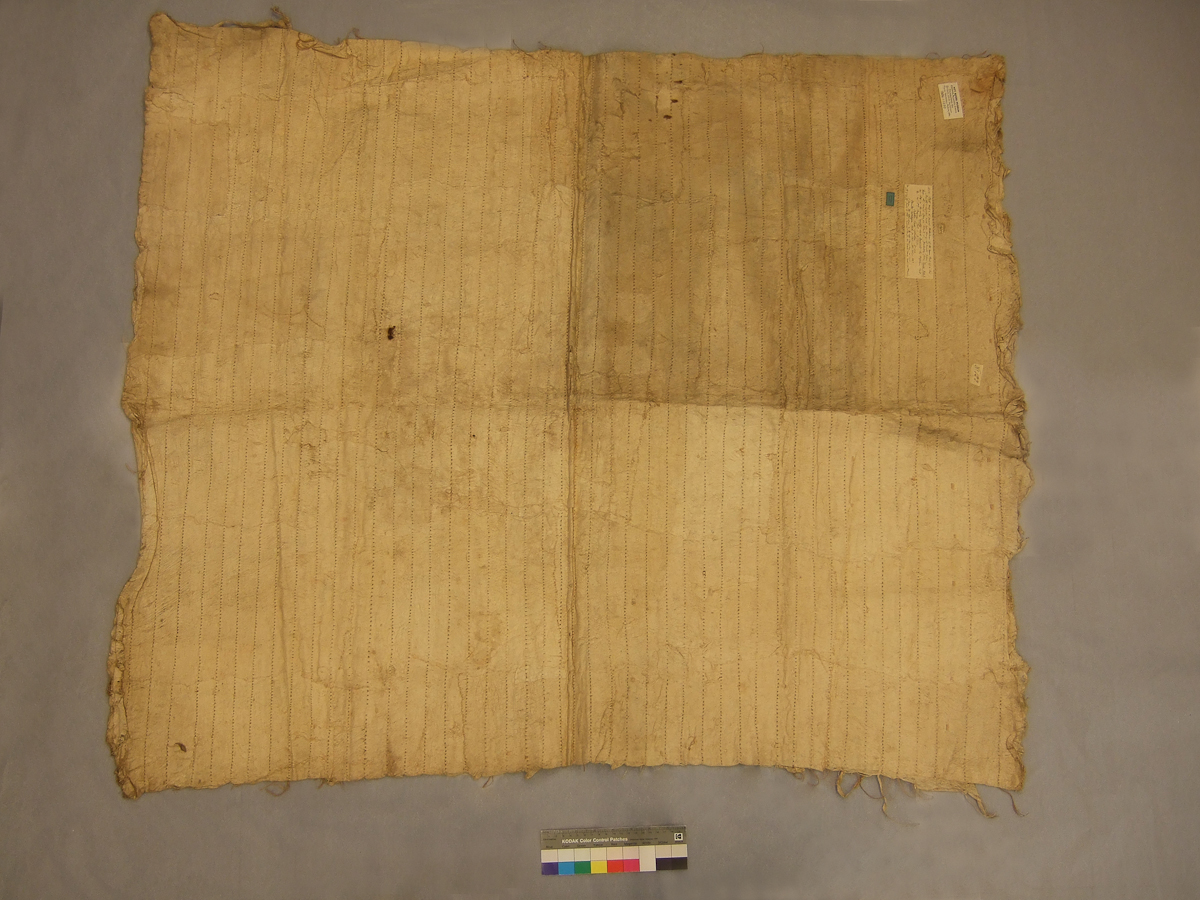
This is another piece of barkcloth from Cook's second voyage - Forster No.49, listed in the section for the Friendly Isles (Tonga) as 'A piece of their brown cloth.'

1886.1.1239 Barkcloth, Tonga


Original Forster number label, together with labels added at the Ashmolean Museum before transfer to the Pitt Rivers in 1884.

Barkcloth, together with mats, are amongst the possessions most important to Tongans, who regard them as koloa, or wealth.  Adrienne Kaeppler write in her essay 'Tonga - Entry into Complex Hierarchies' in 'James Cook - Gifts and Treasures from the South Seas. The Cook/Forster Collection, Gottingen' Prestel-Verlag, Munich 1998, that 'koloa, made by women, are complimentary to ngaue, products derived from agricultural work and animal husbandry, and produced by men.  Koloa, products made by women, are prestigious, as are the women themselves.  In contrast, products made by men are considered 'work', and like the men are powerful.  The ngaue of men regenerates people physically, while the koloa of women regenerates them culturally.  Both are necessary to regenerate and reproduce society…the fabrication of koloa is not a craft, but a fine art which creates valuables, an important distinction in Tongan culture.'

The majority of barkcloth on Tonga is made from the paper mulberry.  At the time of Cook's voyages, the bark was stripped from the tree and briefly soaked to soften it.  The strips were placed on a wooden anvil and beaten out with a grooved beater, folding them and beating several thicknesses, then shaking the folds out and beating again, until the width of the strips had increased from 8-10cm to as much as 50cm.  Two of these sheets were felted together, to form a piece of tapa (on Tonga, this term referred only to undecorated barkcloth) called a feta'aki.  These were dried in the sun, and then stored in the houses of women.  Tapa was thus always available for making ngatu, large decorated sheets of barkcloth.

The ngatu collected by the Forsters in either October 1772 or June 1773 is a ngatu 'uli, or black ngatu.  Sheets of feta'aki were pasted together with arrowroot, and at the same time dye was rubbed into the surface of the barkcloth.  The fact that the sheets were pasted together means that there are no beater marks visible on the surface of the barkcloth, and the texture is different to backcloth from, for example, Tahiti. 

The pasting and dyeing process was carried out on a curved wooden board called a papa 'koka'anga, to which textured tablets or kupesi could be attached to give a pattern to the surface of the finished barkcloth.  The kupesi were usually made from palm leaf and sheath, carrying an embroidered relief design, or coconut fibre cords and leaf midribs were attached directly to the wooden base.  These design tablets could not withstand being beaten, hence the need to paste and rub the feta'aki strips together. Sometimes matting was stretched over the papa to form a design, and this is what seems to have been used on the central panel of the Pitt Rivers barkcloth. 

Pattern on the surface of the central panel

The border has a design of parallel lines, similar to patterns formed by using cords attached to the papa directly. 

Pattern on border panels
 (See Kooijman, 'Tapa in Polynesia', Bernice P. Bishop Museum Bulletin 234, Bishop Musuem Press, Honolulu, Hawaii 1972).  

A liquid brown dye was obtained from the bark of the koka tree (Bischofia javanica, Bishopwood) and this was rubbed into the surface of the ngatu using a pad of barkcloth.  The dye probably helped the layers to stick together, and gave the surface a glazed appearance.  The surface was blackened using a dye in powder form, fukai tutui, made from burnt candelnuts (Aleurites moluccana), which was sprinkled over the surface of the ngatu and rubbed in with a pad soaked in koka dye.  The black dye was difficult to make, requiring several days and nights of work, and was one reason for the high status of ngatu 'uli. 

Monday, 17 December 2012

Plant Identification, and a 'fine and beautiful braid of human hair'

Last week, Caroline Cartwright from the Department of Conservation and Scientific Research at the British Museum came to visit us at the Pitt Rivers.  Caroline is an expert in the identification of plant fibres, and she will be carrying out some ID work for the Conserving 'Curiosities' project.  

In a previous blog post I mentioned that the investigation of the materials from which objects are made can give us information about where they come from - even though the Forster collection in particular is relatively well documented, there is still confusion about this.  Even when we know for sure where an object comes from, like this unique barkcloth from Easter Island (Rapa Nui), some of the materials still remain unidentified.  

1886.1.1250 Barkcloth, Easter Island

The barkcloth has decorative bands of plant material sewn across each end - said to be a rush that grows in the bottom of the extinct volcano (Rano Kau) on Easter Island.  A cord made from plant fibre was used to sew the layers of barkcloth together at intervals - almost like quilting.  

1886.1.1250 Detail of stitching and fibre
  
Other material that Caroline will look at includes plant fragments found in this headdress.  

1886.1.1685 Tamau Headdress, Tahiti

This is Forster No. 40, 'The Tamow, or headdress of plaited hair.'  Considered to be a 'lost' Forster object, it was found under the bindings of the Tahitian Mourner's costume.  

The tamau as found on the headdress of the Mourner's costume

The tamau was made of many metres of plaited human hair, made to form a continuous length.  It was worn by women as they danced, and the centre was filled with flowers.  

A young woman of Otaheite Dancing, after John Webber

George Forster, in 'A Voyage Round the World', saw a dance performance in the Society Islands in September 1773. He talks about the dress of the dancers, which included 'Poyadua (Poedua), the fair daughter of the chief Orea'…

'The neck, shoulders and arms were left uncovered, but the head was ornamented with a kind of turban, about eight inches high, made of several skains of plaited human hair, which they call tamow.  These being laid above each other in circles, which enlarged towards the top, there was a deep hollow left in the middle, which they had filled up with a great quantity of the sweet-scented flowers of the (gardenia) cape jasmine.  But all the front of the turban was ornamented with three or four rows of a small white flower, which formed little stars, and had as elegant an effect on the jetty black hair as if it had been set with pearls.'

William Ellis also described a group of dancers on Tahiti in 'Polynesian Researches', published in 1831.

'The daughters of the chiefs, who were the dancers on these occasions, at times amounted to five or six, though occasionally only one exhibited her symmetry of figure, and gracefulness of action.  Their dress was singular, but elegant.  The head was ornamented with tamau, a fine and beautiful braid of human hair, wound around the head in the form of a turban. *  A triple wreath of scarlet, white and yellow flowers, composed of the aute, the fragrant gardenia, or Cape jessamine, and the baslaria laurifolia, tastefully interwoven, adorned the curious head-dress.

* Mr Barff, to whom I am indebted for the principal part of this account, procured a head-dress of this kind, containing one hundred fathoms of the finest braided human hair.'  

One hundred fathoms is about 180m.  It is likely that the tamau in the Pitt Rivers collection contains closer to 1000m of hair.  

Fragments of plant material were taken from this and several other objects, and we hope that with Caroline's help some of the questions that people have been asking about the Cook-voyage collections for several hundred years might finally be answered. 

Thursday, 6 December 2012

Pesticides on Museum Objects

Part of the Cook-Voyage project at the Pitt Rivers is to look at the question of pesticide residues on objects from the collections.  Chemicals have always been applied to objects in museum collections to protect them from pests, mainly insects, which can cause a lot of damage. 

As the Forster Collection has been in Oxford since 1776, and the Banks collection was at Christchurch even before that, the Cook-voyage collections potentially span virtually the whole history of pesticide use in museums.  Even though we know that chemicals such as arsenic, mercury and DDT, were routinely applied to museum collections, finding evidence of what was actually done is difficult.  

Label from a poncho from the Tahitian Mourner's costume, giving information on the condition of the feather cape.

A label on the Tahitian Mourner's costume, written just before the Ashmolean's ethnographic holdings were transferred to the Pitt Rivers in 1886, records that the cloak was 'now in a very bad condition' and an entry in the Accession Registers goes on to say that this was 'through the moth, and (it) has been removed to the Museum in the Parks (Oxford University Natural History Museum) and placed under the charge of Professor Moseley to be fumigated.'  We don't know, however, what fumigation involved. 

Sometimes, the Pitt Rivers annual reports give us more of a clue.  In 1946-47, the Curator, T.K. Penniman, wrote that 'we have tried the Clymax spray on all of our material, and have found it thoroughly effective in destroying every sort of pest that attacks every sort of material that human beings use.'  Powerful stuff indeed!  There is also a mention of a fumigation chamber being built so that methyl bromide gas could be used to kill pest infestations on museum objects, but it is not clear whether this was ever actually used.  

Jeremy Uden and Kloe Rumsey, conservation intern, taking samples of surface deposits from a Tongan mat.
  
The analysis of pesticide residues is being done for us by Andrew Charlton, an analytical chemist at the Wildlife Incident Unit, part of the Food and Environment Research Agency.  He usually works on investigating pesticide uptake by wildlife, especially honey bees.  The samples he works on are usually destroyed during the analysis - not something that is practical for museum objects.  We are using cotton wool swabs dampened with distilled water to take samples of the surface dirt and residues from objects - we know that the object is not damaged in the process, which is of paramount importance, but we have to accept that we may not be able to get large amounts of any residues remaining on the surface onto the swabs. 

Once Andrew receives the swabs, any residues on them are extracted with an organic solvent for analysis using gas chromatography - mass spectrometry (GC-MS), a highly sensitive technique which can detect parts per billion (ppb) levels of target pesticides.  Each target pesticide is detected in the mass spectrometer by the presence of characteristic molecular fragments providing a unique ‘fingerprint’.  To detect the presence of arsenic or mercury compounds, swabs are extracted with dilute acid for elemental analysis by inductively coupled plasma - mass spectrometry (ICP-MS).  Argon plasma at a very high temperature (approximately 6000 to 10000°C) is used to turn the sample solution into ionised atoms (ions). Each element produces ions with a characteristic mass and charge, which are detected by the mass spectrometer. ICP-MS can detect residues of arsenic or mercury pesticides in the swabs at ppb levels.

Cotton wool swabs used to remove surface deposits from a fragment of feather from the Tahitian Mourner's costume cloak.

The results of the analysis will help us to understand how pesticides were used in the museum, and may help answer questions we are starting to ask about whether the pesticides have contributed to damage, such as staining and deterioration in certain areas of some of the objects.  The results will also help us to make sure that the precautions we routinely take when we handle objects, such as wearing gloves and lab coats, are effective.